
Title
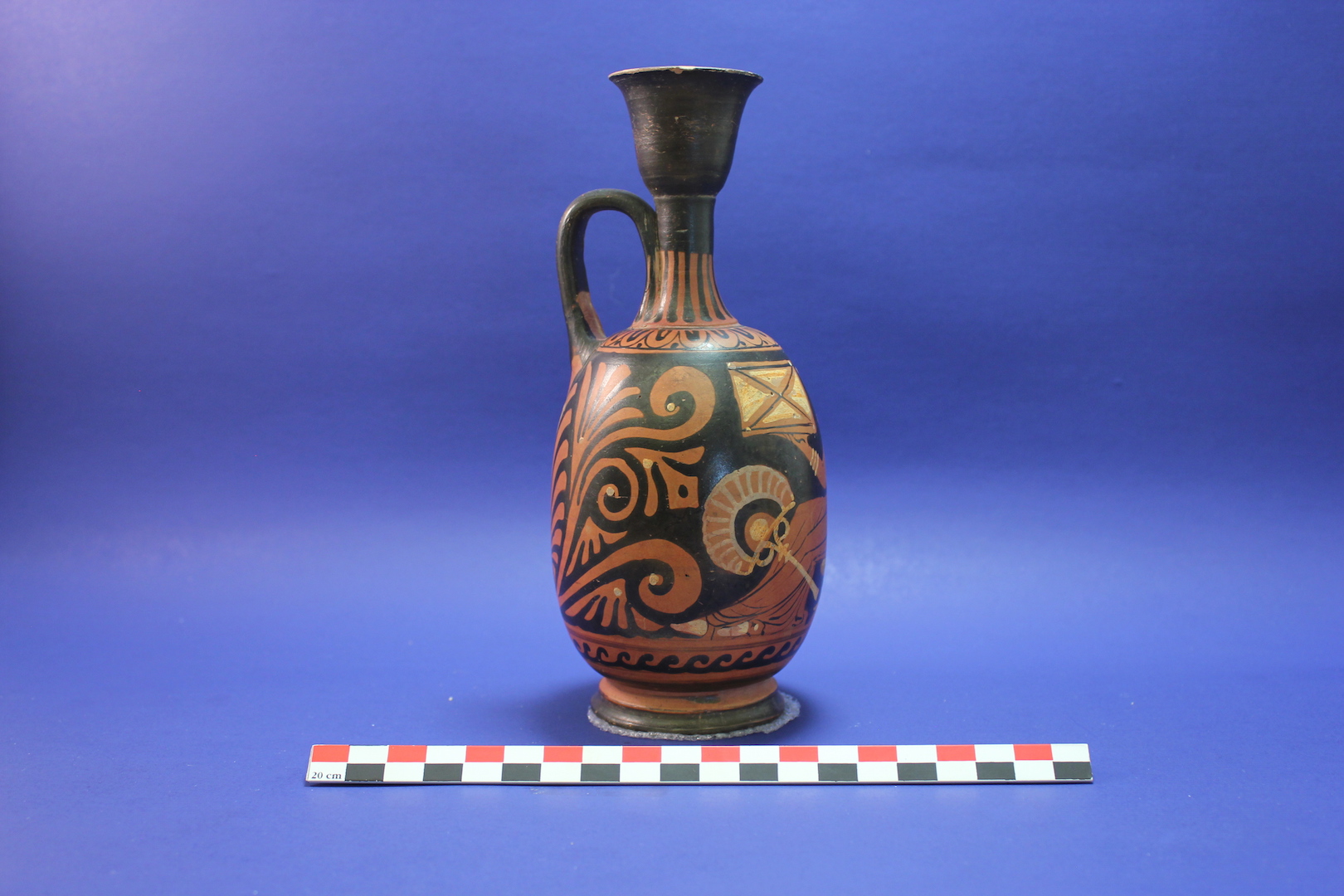
Apulian red-figure lekythos
Date
Circa 340-320 BCE
Creator
Patera Painter (Greek vase painter, active ca. 340-ca. 320 BCE in Apulia)
South Italian
Coverage
Style/Period: South Italian; Apulian; red-figure vase paintings (visual works)
Discovery Site: Discovered in Eastern Apulia (Puglia), Bari province, Italy
Repository: Museum of Classical Antiquities, University of Ottawa / Musée d'antiquités gréco-romaines, Université d'Ottawa
Collection: Donati Collection
Type
decorative art|containers|religious and cult objects|culinary equipment|social and religious practices|vase painting
Format
Materials/Techniques: terracotta (clay material); throwing (pottery technique); red-figure vase painting (image-making)
Measurements: Body: 18 cm high, 9 cm wide; base: 6 cm in diameter; mouth: 4 cm in diameter
Description
The artefact is a small lekythos painted in the red-figure style. Its mouth, handle and top-half of its neck are painted in black. The bottom-half of the neck has a pattern of descending vertical lines leading into an ogive pattern on the shoulder. On its obverse is depicted a woman sitting in profile on a stylized bench, holding a cista in her right hand and a lanyard attached to a disc painted with a dotted-octothorpe in her left. She is facing the cista, looking to her right. She wears a belted Ionian chiton. As jewellery she wears three bracelets on her right arm, two on her left, earrings and a beaded necklace. Her hair is put up into an open-wrapped jewelled kekryphalos, with decorative lines emanating from it. Resting on her legs is a fan. Decorative and space-filling elements float around the figure of the woman; around her hair, behind her left arm and her back. On the reverse is an intricate palmette that spirals out into vegetal-patterned tendrils across the surface, filling out the entirety of its reverse. On the lower body of the vase, under the woman’s figure, is a continuous running wave pattern framed by two thin and fading black bands. The base is composed of two bands; one in reserve and the other painted black. As is consistent with the red-figure style, the details and outline of the woman’s figure are painted in black prior to firing. The figure, the palmette pattern and the other decorative elements are left in reserve. There is use of white over-paint applied prior to firing to add detail on the fan, the woman’s jewellery, the bench, the cista, the disc and on other floating decorative elements. There is also an addition of white painted dots on the palmette motif.
Identifier
Repository Accession Number: 2014.5.6
Record: UO-MCA-2014-5-6
Source
Cataloguer: Chloe Storm, University of Ottawa
Photographer: Marina Guirguis, University of Ottawa
Image Date: 2014
Rights
The images are provided by the Museum of Classical Antiquities, University of Ottawa. For contact information, visit the Museum website: https://arts.uottawa.ca/cla-srs/en/museum | Les images sont fournies par le Musée d'antiquités gréco-romaines de l'Université d’Ottawa. Visitez le site du musée pour les coordonnées : https://arts.uottawa.ca/cla-srs/fr/musee