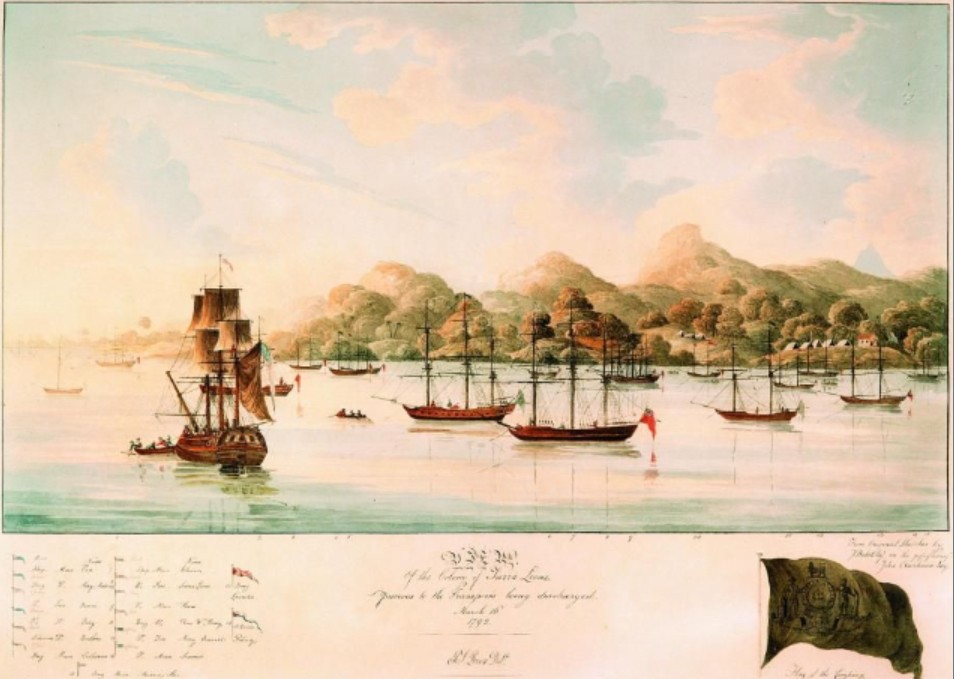
Black Loyalists Arriving At Sierra Leone
Dublin Core
Title
Black Loyalists Arriving At Sierra Leone
Description
This watercolour represents the arrival of Black Loyalists in Sierra Leone, an act of defiance following the disappointments of life in Nova Scotia. For those who left, the journey was more than just an escape, as it meant a chance to build a community from the ground up, where freedom, land, and autonomy might finally be abundant. The Black Loyalists would build a settlement named “Freetown” upon the land, which still stands to this day as the capital and largest city in Sierra Leone. Historical records show that conditions in the colony were harsh and uncertain: struggles with disease, bugs, an unfamiliar climate, and limited resources were commonplace. But unlike the continuous marginalization experienced in Canada, life in Sierra Leone was marked by a persistent sense of hope, as these folks believed they could finally shape their own destinies.
Thus, this painting shows that resistance could take diverse forms based on scale and configuration, ranging from the escape of a singular enslaved person to the migration of hundreds across the globe. And sometimes, especially for the Black Loyalits of Sierra Leone, performing resistance also meant leaving yet another oppressive society behind, and seeking freedom an ocean’s length away.
Thus, this painting shows that resistance could take diverse forms based on scale and configuration, ranging from the escape of a singular enslaved person to the migration of hundreds across the globe. And sometimes, especially for the Black Loyalits of Sierra Leone, performing resistance also meant leaving yet another oppressive society behind, and seeking freedom an ocean’s length away.
Creator
George James Rowe
Source
Rowe, George James. Black Loyalists Arriving at Sierra Leone. c. 1792–1820. Nova Scotia Museum. https://museum.novascotia.ca/collections-research/made-used-found/gallery/objects/painting-black-loyalists-arriving-sierra-leone
Publisher
Nova Scotia Museum
Date
1792
Rights
Public Domain
Type
Watercolour Painting
Files
Citation
George James Rowe, “Black Loyalists Arriving At Sierra Leone,” Black Canadian History Exhibit, accessed April 29, 2026, http://omeka.uottawa.ca/mathieu-black-canadian-history-exhibit/items/show/434.