
Browse Exhibits (6 total)
Projects / Projets
Here is a selection of student projects that merge Latin American studies with Digital Humanities tools. Through undergraduate courses in Political Studies, History, and Modern Languages at the University of Ottawa, students engage with Latin America’s diverse histories, cultures, and contemporary issues using digital platforms. They also explore new approaches to developing their final projects and implementing active learning.
*****
Voici une sélection de projets étudiants qui associent les études latino-américaines aux outils des humanités numériques. À travers des cours de premier cycle en études politiques, en histoire et en langues modernes à l’Université d’Ottawa, les étudiants explorent les diverses histoires, cultures et enjeux contemporains de l’Amérique latine en utilisant des plateformes numériques. Ils découvrent également de nouvelles approches pour développer leurs projets finaux et mettre en œuvre un apprentissage actif.
 La représentation médiatique des revendications territoriales chez les peuples autochtones du Brésil et du Chili
Ce projet analyse la problématique de la représentation médiatique dans le cadre des luttes et revendications territoriales modernes des peuples autochtones d’Amérique latine. Plus précisément, nous nous intéressons à la manière dont ces actions, qui s'inscrivent dans une perspective décoloniale, sont représentées par les médias écrits francophones et comment les choix éditoriaux utilisés dans ces articles contribuent-ils à perpétuer ou à remettre en question la colonialité en Amérique latine. Notre projet analyse deux cas type : Le peuple Xokleng au Brésil et les Mapuches du Chili.
Afro-Descendent Racial Governance in the 20th Century: Brazil and Argentina
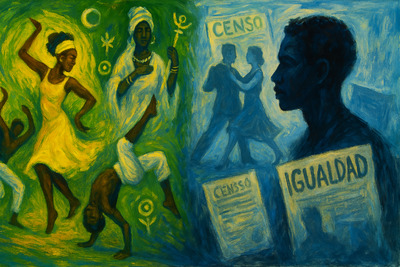
Visual interpretation by Audrey Lacroix. This digital composition explores Afro-descendent identity and racialized governance in 20th-century Argentina and Brazil.
How were Afro-descendant populations included or excluded from the official nationalidentity narrative under Juan Domingo Perón in Argentina and Getúlio Vargas in Brazil?
Narrated by Justine Brown. Audio introduction Abstract.
Here on this website you will be able to access all of our findings regarding racial governance in the 20th century as part of our comparative analysis of Afro-Descendant experiences in Brazil and Argentina. We will guide you through the socio-political landscapes of both countries during the leadership of Getulio Vargas in Brazil and Juan Domingo Peron in Argentina throughout the mid to late 1900s. Our analysis will follow the treatment and integration of Afro-Descendant populations in both countries during that time period all the way until present day. Throughout this experience, we pose the question “How were Afro-descendant populations included orexcluded from the official national identity narrative under Juan Domingo Perón in Argentina and Getúlio Vargas in Brazil?”. Click on any of the sound bites to hear and/or read about Brazil, Argentina, their past and present governments, their similarities and differences as well as the evolution and next steps for both.
Narrated by Audrey Lacroix. Audio introduction Basic Concepts.
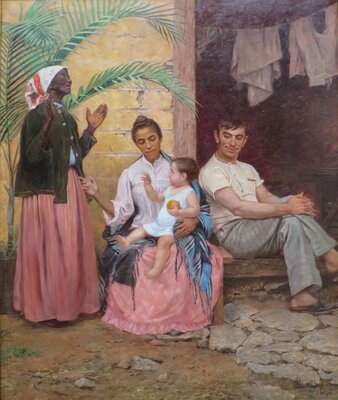
A Redenção de Cam, Modesto Brocos, 1895. Public domain via Wikimedia Commons.
To understand how Afro-descendant populations were either included or excluded out of national identity under Getúlio Vargas in Brazil and Juan Domingo Perón in Argentina, it’s important to recognize that national identity itself isn’t a neutral reflection of the population. Rather, it’s a political construction that is often shaped by those in power. In mid-20th-century Latin America, political leaders crafted narratives of the “nation” not just to unify people, but to legitimize their authority and define citizenship, frequently along racial lines (Williams, 2016; James, 2001).
In Brazil, Vargas’s government embraced the ideology of mestiçagem, or racial mixing, as a key pillar of Brazilian identity. This idea promoted the notion that Brazil had overcome racial divisions and evolved into a harmonious multicultural society. Yet scholars argue that the myth of racial democracy masked deep and ongoing racial inequalities. Afro-Brazilians, in particular, continued to face systematic marginalization despite being celebrated as part of Brazil’s cultural fabric (Williams, 2016).
During the Estado Novo period (1937–1945), Vargas led a sweeping cultural campaign that elevated symbols like samba, Carnaval, and capoeira into official representations of Brazilian identity. These traditions, rooted in Afro-Brazilian communities, were publicly celebrated, but often only in sanitized, state-approved forms. Behind the scenes, the state censored and controlled these expressions, while Afro-Brazilian religious practices and independent cultural activities were surveilled or even criminalized (Williams, 2016).
This dynamic is often described as symbolic inclusion without material equity. Afro-Brazilian culture was held up as a national emblem, but Black Brazilians themselves remained excluded from political office, economic opportunity, and academic influence. In essence, Blackness was made central to the idea of Brazil, without granting Black people real power or visibility within the institutions that shaped the country (Williams, 2016).
Argentina, meanwhile, followed a different racial path. From the late 19th century onward, the country pursued blanqueamiento, which is a policy and ideology aimed at creating a white, Europeanized nation. This included actively encouraging European immigration while erasing Afro-Argentine histories from public education, media, and national memory (Populism and New Nationalism, 2003). By the time Perón came to power in the 1940s, this whitening project was already well-established.
Perón’s administration extended new rights to working-class Argentines, rural migrants, and internal laborers, expanding access to education, labor protections, and political participation (James, 2001). But this vision of el pueblo, meaning the people, was narrowly defined. It largely centered on white or mestizo Argentines from the provinces, excluding Afro-descendants, who by then had been removed from official census data, school curricula, and most forms of public representation (Populism and New Nationalism, 2003; James, 2001).
Although Peronism celebrated mass participation and glorified the descamisados (the shirtless working poor), Afro-descendant communities were largely absent from the imagery and iconography of the movement. Cultural elites writing in journals like Sur even framed Peronism as a threat to “civilized” culture, language that was often racially coded. Meanwhile, state propaganda emphasized a unified, ethnically white national identity (Populism and New Nationalism, 2003).
What we have in both instances is the manner in which national identity was carefully built in a way of favoring some racialized accounts over others. Afro-descendant communities were either selectively included through appropriated cultural symbols or excluded altogether from the official image of the nation. Understanding these dynamics is crucial to challenging the enduring myths of national homogeneity and racial harmony, and to observing how racialized governance continues to influence citizenship, belonging, and visibility across Latin America today.
 Modern Latin America