Connections to the U.S.
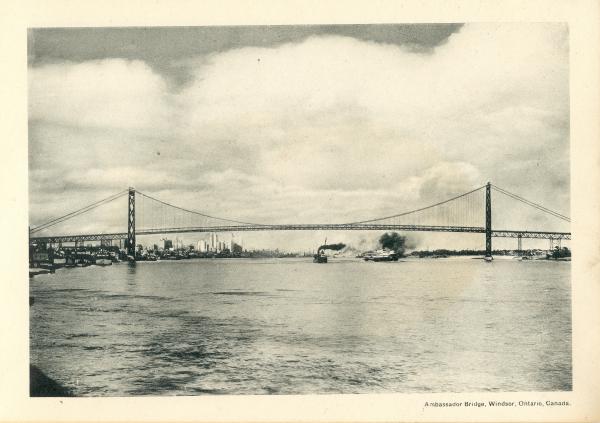
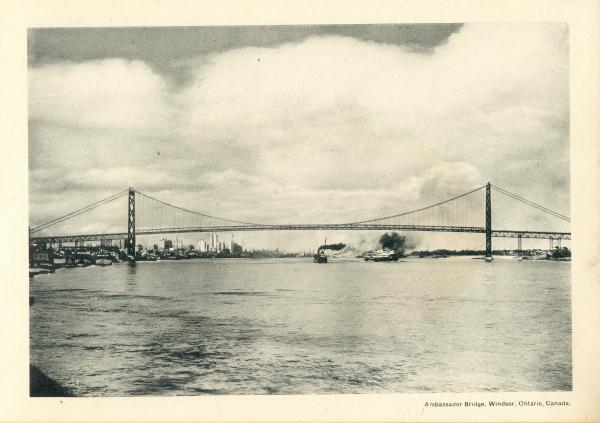
The Windsor-Essex's region has long been defined by its unique position alongside the Canada-U.S. border. Directly across from Detroit and linked by major crossings like the Ambassador Bridge and the Detroit-Windsor Tunnel, Windsor and the broader Essex County area have developed alongside, and in response to, their American neighbours. This proximity has shaped nearly every aspect of the region's development.
In the 20th century, these connections deepened during moments of international crisis. During both World Wars, the border came became a site of military coordination and industrial cooperation, with Windsor-Essex contributing significantly to Canada's war effort while closely tied to Detroit's booming defense production.
Outside wartime, Windsor-Essex's relationship with the U.S. evolved through events like Prohibition, when Windsor became a hub for smuggling liquor into dry American cities, and through the development of the automotive industry, which fostered binational labour movements and supply chains. In the postwar period, changing trade policies, increased border security, and cross-border education and tourism continued to shape the region.
The Windsor-Detroit border has functioned as a fluid and contested space, one that has shaped the very identity of Windsor-Essex. While proximity to the United States has long generated economic and political opportunities, it has also blurred the lines between legality and illegality, between cooperation and autonomy, and between local and national interests. The border, in short, has made Windsor-Essex what it is, not by separating it from the United States, but by tying the region to the U.S. in ways both productive and disruptive.
This duality is evident in the visual and textual records featured in this section. Photographs of rum-running routes at Pike Creek, satirical postcards, and the figure of Blaise Diesbourg capture how local actors turned federal prohibition policy into opportunity. In these years, Windsor-Essex did not just mirror American developments, it adapted to and capitalized on them. The border became a flexible resource, mobilized by ordinary people navigating two legal systems, two economies, and two sets of moral codes.
The wartime industrial exhibits, particularly those related to Hiram Walker’s U.S. Army ration production, point to a different kind of transnational relationship: one based on wartime necessity and binational coordination. In these moments, Windsor’s industrial identity expanded beyond the national frame, participating in a broader North American defense infrastructure. But this integration also carried consequences; postwar trade and security regimes redefined local autonomy, tethering Windsor-Essex more tightly to U.S. economic policy and border governance.
Even images of infrastructure such as the Ambassador Bridge, the Detroit-Windsor tunnel, and ferry crossings, speak to the cultural meanings of mobility in Windsor-Essex. These crossings are more than logistical conveniences; they symbolize a shared regional culture that transcends national borders. But they also expose the region’s vulnerability to external forces, as increased border securitization in the post-9/11 era complicated long-standing patterns of movement, family life, and employment.
As scholars like Brandon Dimmel and Ernest Lajeunesse remind us, the Windsor-Detroit corridor is not just a site of trade or smuggling—it is a lived space of overlapping sovereignties, shaped by improvisation, resilience, and entanglement. The artifacts in this exhibit encourage us to reconsider the border not as a boundary but as a relationship, one that continues to define Windsor-Essex in ways both visible and unseen.