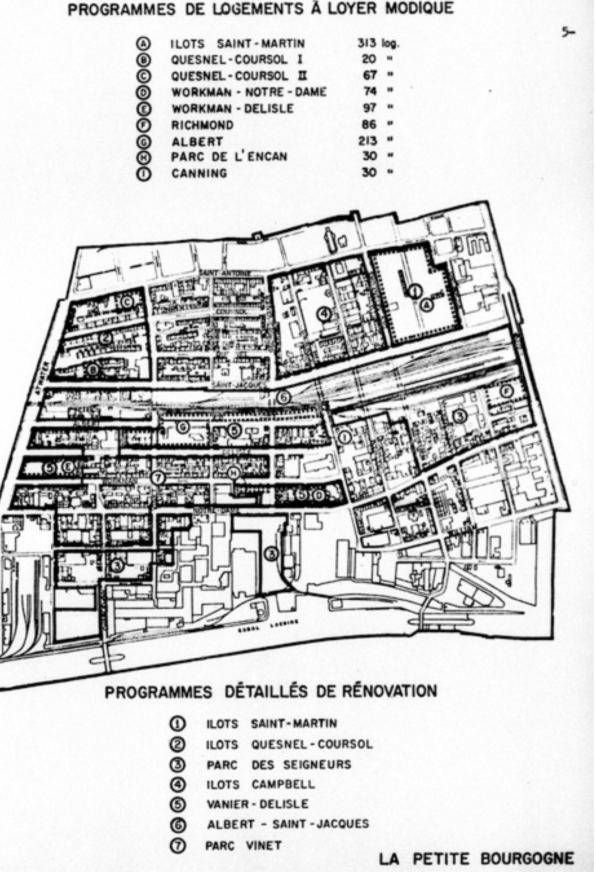
The Stages of the Little Burgundy Urban Renewal Project
Dublin Core
Title
The Stages of the Little Burgundy Urban Renewal Project
Subject
Urban Renewal in Little Burgundy
Description
The name Little Burgundy (St. Antoine District) only became a recognized neighbourhood name in the 1960s, when city officials used it to label an ambitious urban renewal project. For decades, the community had been heavily dependent on railway employment, which provided stable work and a sense of economic security. When passenger train travel declined in the 1950s and 1960s, hundreds of Black men were laid off, creating immediate financial hardship. At the same time, the city reorganized urban space to prioritize white suburban commuters, constructing new highways that cut directly through the northern part of the neighbourhood demolishing large sections to make way for public housing. These twin pressures of economic collapse and forced displacement threatened to erase the community and its vibrant culture.
Yet the residents of Little Burgundy fought to preserve their identity. Jazz clubs, restaurants, and social hubs like the Black Bottom became critical for resistance, providing spaces to gather, celebrate their culture, and assert their presence despite systemic efforts to push them out. Even as the community dispersed and its culture faded slowly over the decades, initiatives today are actively working to revive and honor Little Burgundy’s rich heritage. Cultural events, heritage walks, and museums now celebrate the neighbourhood’s jazz history, its Black-owned businesses, and the stories of resilience that defined this vital Montreal community, bringing the spirit of Little Burgundy back to life for new generations.
Yet the residents of Little Burgundy fought to preserve their identity. Jazz clubs, restaurants, and social hubs like the Black Bottom became critical for resistance, providing spaces to gather, celebrate their culture, and assert their presence despite systemic efforts to push them out. Even as the community dispersed and its culture faded slowly over the decades, initiatives today are actively working to revive and honor Little Burgundy’s rich heritage. Cultural events, heritage walks, and museums now celebrate the neighbourhood’s jazz history, its Black-owned businesses, and the stories of resilience that defined this vital Montreal community, bringing the spirit of Little Burgundy back to life for new generations.
Creator
La Petite Bourgogne: Rapport general
Source
The Stages of the Little Burgundy Urban Renewal Project, Ville de Montréal, Service d’Urbanisme. La Petite Bourgogne: Rapport general, September 1966. CA M001 VM097-Z-D026, Archives de Montréal, Montreal, Quebec, Canada
Publisher
Archives de Montréal
Date
September 1966
Contributor
Archives de Montréal
Rights
Archives de Montréal
Type
Document
Files
Citation
La Petite Bourgogne: Rapport general, “The Stages of the Little Burgundy Urban Renewal Project,” Black Canadian History Exhibit, accessed April 29, 2026, http://omeka.uottawa.ca/mathieu-black-canadian-history-exhibit/items/show/394.