
Browse Items (9 total)
-

Conversation with Tamara Toledo from the Latin American Canadian Arts Project (LACAP)
We interviewed a representative-Tamara Toledo-- of the Latin American Canadian Arts Project or LACAP. Their mission showcased a good example of support for the community, by the community. Tamara's passion was infectious: “Because my background is in the arts, that sort of has been my focus with that activist intention of changing how art is understood, accepted, and the narratives that are a part of the Canadian dialogue.”
LACAP is a Toronto-based organization that helps contemporary Latin American artists who are living in Canada connect to resources, such as help with exhibitions and research. They also provide public programming. LACAP frequently works with Toronto's institutions, such as Ontario College of Art & Design University (OCAD) and York University, providing lectures and seminars about Latin American artists and the history of Latin American art. LACAP’s two founders are Tamara Toledo and Rodrigo Barreda, who is in operations management. Toledo’s background in Art history and curation allows her to understand the artists' needs on a deeper level and provides mentorship for up-and-coming Latin artists. Having attended OCAD herself, she first-hand encountered the issues that many fellow artists were experiencing, allowing her to work directly with the University's programming to create a more inclusive curriculum.LACAP only has two paid employees; everyone else is contracted, depending on project funding. In 2025, they had 3 paid staff who received payroll thanks to an additional grant they received. In general, the organization relies heavily on a fluctuating number of volunteers, meaning that lots of people are constantly coming and going.
LACAP is always looking for helping hands--you can apply on their website if you are interested in getting involved with the Latin arts community.One of LACAP’s main initiatives is Sur Gallery, located right on Toronto's Waterfront. The gallery is a dedicated space used to present contemporary Latin American and LatinX art. This venue and its programming focus on the dialogue between artists, scholars, and communities while encouraging collaboration across borders and artistic disciplines: “Initiatives are aimed to socially innovate, critically engage, lending itself to opportunities of national relevance to begin to develop global networks of exchange.” (LACAP, 2026) Toledo saw the lack of Latin American representation in the art scene of Toronto and understood the issues many Latin artists were experiencing throughout the art community. This left her and her partner to create LACAP to allow the artists to build a strong foundation in their craft to succeed in the Canadian art world. One of her favourite projects is at the Sur Gallery. She visited four Canadian cities and interviewed 15 Latin American artists for the exhibit. Toledo and her team curated a series of video interviews, forming video portraits of Latin American artists across the country, providing a platform for the artists' voices and experiences.
One of the ways you can support this organization is by donating. In this context, dollars go toward promoting Latin American art in different ways, such as by inviting classes to visit their galleries, by providing resources to artists for seminar-style workshops, or by supplying art tools to beneficiaries in the community. These donations can be made by cheque or via their website: https://lacap.ca/support-lacap/donate/. You can also visit their most recent project, Sur Gallery, by appointment only (for now), situated at 100-39 Queens Quay East in Toronto, Ontario.
The work that the organization does is incredibly important as it acts as one of the only support bodies for the Latin American art community in Canada. LACAP strives to employ a mainly grassroots approach, as explained by Tamara in our interview: “(...)20 years ago there was a lack of representation, visibility, of the Latin American diaspora in galleries and institutions, and so for me the motivation was to change that and to create that change and it had to be done from a grassroots place.”
The gallery plans for the long term; The Covid epidemic required them to shift gears and create alternative plans to showcase their artists. Currently, LACAP is undergoing structural and organizational changes, in order to continue to serve their community as best as they can by responding to constantly changing needs. -
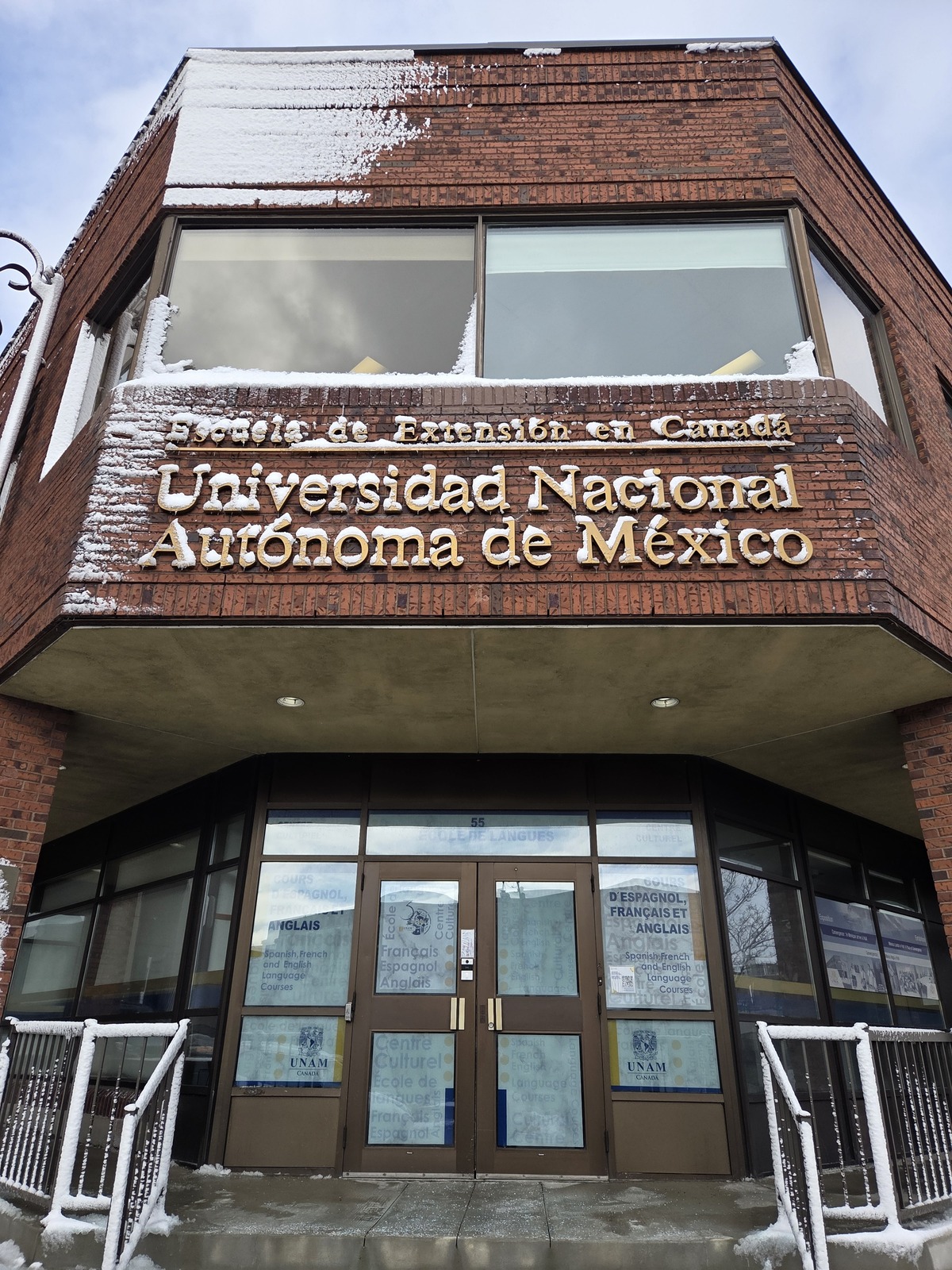
Conversation with UNAM-Canada
The organization we interviewed for this project is UNAM-Canada, an extension of the Universidad Nacional Autónoma de México (UNAM), Mexico’s largest and oldest public University. UNAM has thirteen international offices located in multiple countries, such as the United States, France, Germany, Spain, China, Chile, and, more recently, the United Kingdom. Founded in 1995, UNAM-Canada serves as the university’s international office in Canada. Located in downtown Hull, in Gatineau, this extension currently employs eighteen staff members. As part of this project, we interviewed Alex Méndez, the Academic Affairs Chief Executive at UNAM-Canada, and Brenda Colín, the Administrative Lead at UNAM-Canada.
The UNAM-Canada primarily offers language courses in Spanish, French and English, as well as courses on Mexican and Latin American culture, welcoming more than 800 students each year (Unam Canadá 2019). Most of the students enrolled in Spanish courses come from the region and generally fall into two main categories. The first group consists mostly of retirees who enjoy traveling to Latin America and would like to improve their Spanish skills. The second group includes government employees or professionals who require Spanish for specific purposes and therefore will take classes with UNAM-Canada. When it comes to English and French courses, most participants are international students from UNAM in Mexico. In fact, twice a year, during the summer and winter semesters, the school holds a program called PUMA+. Through this program, Mexican students spend three weeks in Canada developing their English and French skills. In addition, UNAM-Canada is one of only two accredited institutions in Canada authorized to offer the SIELE examination, which provides an internationally recognized certification of Spanish language proficiency (Unam Canadá 2026). As a result, UNAM-Canada has established itself as one of the most important language learning institutions in the National Capital region, especially regarding the teaching and the certification of the Spanish language.
Furthermore, another important aspect of UNAM-Canada is its connection to the broader UNAM network, widely recognized as a hub for research and innovation across multiple disciplines (TV UNAM 2017). Indeed, during the interview, it was pointed out that UNAM is involved in a wide range of scientific and academic fields. As Brenda Colín explained, UNAM has developed many important contributions that not everyone knows about: it has its own satellite. It also has two research vessels. By sharing these achievements through its Canadian programs, UNAM-Canada helps bring greater visibility to the global impact of Mexican and Latin American research. This is not only beneficial for raising awareness among local Canadian communities, but also for highlighting the key role that Latin American institutions like UNAM has in developing knowledge on a global scale.
In addition to promoting the Spanish language, as well as Mexican and Latin American culture, UNAM-Canada’s mandate is to build academic bridges between Canada and Mexico and to further strengthen UNAM’s presence abroad. One clear example of this would be the many Mexican students who come to Canada to conduct research at universities such as the University of Ottawa, Concordia University, and McGill University. These academic exchanges are actively supported by UNAM-Canada, which has been collaborating with regional universities to develop and expand such opportunities over time. UNAM-Canada also serves as an important venue for conferences, round tables, book and film presentations, symposiums, as well as painting and photography exhibitions, in addition to concerts and theatre performances. The institution has classrooms, a specialized library focused on Mexican and Latin-American books, a cafeteria and a multipurpose room that functions as both an auditorium and art gallery (Unam Canadá 2019). Moreover, UNAM-Canada is widely recognized for organizing the Day of the Dead celebration in collaboration with the Embassy of Mexico and the City of Gatineau. Every year, the institution installs an altar, either in the school’s multipurpose room or at Gatineau’s city hall and hosts a variety of cultural activities related to the celebration, bringing together members of the regional community.
We decided to interview UNAM-Canada because of its importance in promoting Mexican and Latin American culture in the National Capital Region. Although this university mainly focuses on language courses and Mexican and Latin American cultural activities, its impact goes beyond the academic sphere. Indeed, the organization actively contributes to strengthening the sense of community in the region by offering activities that encourage relationships between students and citizens. Whether through language courses, a variety of cultural events, or by facilitating academic exchanges between Mexico and Canada, UNAM-Canada fosters intercultural understanding and builds connections between local and international communities. Thus, the university’s participation and the digital archiving of the interview would help make the general public more aware of the important role of this organization in promoting UNAM and Mexico, as well as in strengthening intercultural bonds.
If you would like to learn more about UNAM-Canada, we encourage you to visit their website: https://canada.unam.mx/fr/accueil/
If you would like to learn more about UNAM, we invite you to watch this video: https://youtu.be/8VGgHcOO8TM?si=04-1UyCAJ5kYl0dZ
Bibliography:
Unam Canadá. 2019. “Histoire - Unam Canadá.” Last modified November 12. https://canada.unam.mx/fr/histoire/.
Unam Canadá. 2026. “Service International D’Évaluation De La Langue Espagnole (SIELE) - Unam Canadá.” Last modified February 23. https://canada.unam.mx/fr/service-international-devaluation-de-la-langue-espagnole/.
TV UNAM. 2017, December 6. “UNAM La Universidad De La Nación - Video Institucional.” Video, 4 min., 43 sec. https://www.youtube.com/watch?v=8VGgHcOO8TM. -
Latin Hub Canada
Latin Hub Canada is a non-profit organization that operates in Ottawa. Their mission is to foster the growth of local artists by being the leading platform for international Hispanic and Latin artists, while providing a safe space for them to connect with Canadian audiences. Latin Hub Canada is a local club where Latin artists are able to perform and connect with a Canadian audience on stage, in a way that creates cultural exchange. They are located in Gatineau at 94, rue du Patrimoine.
They were founded by a Cuban-born pianist named Miguel de Armas, and, as of 2023, they are a non-profit organization based in Ottawa, Ontario. They organize activities and soirées showcasing Latin and Hispanic artists in Canada, while helping them gain visibility and opportunities.
They host multiple events such as the Ottawa Latin Jazz Conference, which explores the dynamics of jazz music and includes art exhibits, workshops, and discussions. The Latin Jazz Conference has diverse music and promotes unity.They also host the Fiesta Cubana Fest, which explores Cuban culture, dance, and literary work, with top salsa bands, authentic Cuban cuisine, and cocktails, offering a multitude of flavours. They have 4,307 attendees, 42 activities, 27 bands, and 184 artists.
-
Latin American Soldiers Committee in Canada
The Latin American Soldiers Committee (LASC) is a non-profit organization based in Ottawa. Their mission is to recover names and stories of Latin American soldiers who have served in the Canadian military. Founded in 2022, they have published remembrance books in honour of the veterans and their families.
Their goal is to inspire future generations by telling each other stories. To educate young people and inspire individuals entering the army. They hold ceremonies and events for Latin American Heritage Month, recognizing all the soldiers and those who have made an impact on Canadian history, for example, Major General Michel St-Louis. All while celebrating Latin American culture and heritage.
They advocate not only for the Latin American veterans but also for the communities in which many of those Latin American soldiers were not recognized or documented throughout Canadian history. Collecting the records allowed the group to show its historical and cultural impact by preserving its work.
-
Holas: The Humanitarian Organization of Latin American students
The Humanitarian Organization of American Students (Holas) is a non-profit organization based in Ottawa, specifically at Carleton University, which allows them to have a greater reach and collaborate with different organizations in Latin America and the Caribbean. Their mission is to provide humanitarian aid in Latin America through food, shelter, clothing, and education. They want to eradicate food insecurity in Latin America while also raising awareness of these issues. They aim to reduce poverty and inequality. The club was motivated and driven by a commitment to social responsibility, helping communities back home.
A non-profit founded in 2007 by students in Ottawa. They have helped with humanitarian development in Latin America and in the Caribbean. They have raised 50,000 in development projects. There are about 200 members in HOLA who are actively participating and volunteering.
On their website, there are many pictures of Latin American and Caribbean dance and celebrations featuring traditional costumes. They are partnered with an NGO that allows others to donate to them. They have fundraisers in which they teach free salsa classes with cultural dance groups and folklore. They also host Spanish and Portuguese lessons free of charge for students to learn, practice, and improve their skills. To maintain the group, they meet once a week to discuss upcoming events, allowing students to network.
-
Jamaican Ottawa Community Association
The mission of the Jamaican Ottawa Community Association is to support and empower Jamaican Ottawa-Gatineau residents by creating a community in which all can participate and be involved. They provide services to their members, such as support for elders, resources/information for newcomers, and cultural and educational programs.
The Jamaican Ottawa Community Association was founded in the early 1960s by Carleton University students, and was later federally incorporated in the late 1970s. Also known as the J(O)CA, they are a non-profit organization that aims to support and engage residents in community issues and projects, while also being a pillar of the Jamaican community through its various activities, ranging from celebrations to awareness-raising. This association is currently under the presidency of Claudine Mitchell, who originates from St. Thomas, Jamaica.
The J(O)CA is known for hosting a “JAMDAY” yearly, to celebrate the independence of Jamaica, typically in the first or second week of August. There, you will find good food, music, and a community coming together to celebrate their roots and freedom.
You can sign up to be a member directly on their website, and follow events from their Facebook and Instagram pages.
-
Barbados (Ottawa) Association Inc.
The Barbados (Ottawa) Association (BOA) is a non-profit organization that was founded in 1966, making it the oldest Barbadian association in all of Canada! Their mission entails working closely with similar organizations to help their members find their place in Canada’s changing society, while having a space where they can maintain a close relationship with Barbados. This year, they will be celebrating their 60th anniversary.
It was founded on the same day that the nation of Barbados obtained its independence from the United Kingdom by six Barbadians who wanted to create a space for Barbadian immigrants. This space would help Barbadian immigrants adapt to life in Canada while also sharing their heritage with the Ottawa community. The current president of the BOA is Jacquie Belgrave-Dixon.
The BOA has since organized many cultural, educational, and recreational activities. They host yearly Independence Receptions and Galas in Ottawa, to celebrate the anniversaries of Barbados’ independence and of becoming a Parliamentary Republic. Additionally, they often encourage their members to volunteer in community events in Ottawa, as seen in events like the yearly Ottawa Race Weekend and Ottawa Black Film Festival. Volunteers represent Barbados and support fellow Caribbean and Black communities. They also regularly host recreational activities, such as bowling nights, trivia nights, and “Promoting Healthy Lifestyles” seminars throughout the year.
To see their upcoming events and get updates on the organization, you can reach the Barbados Ottawa Association by email or follow them on their social media pages linked above -
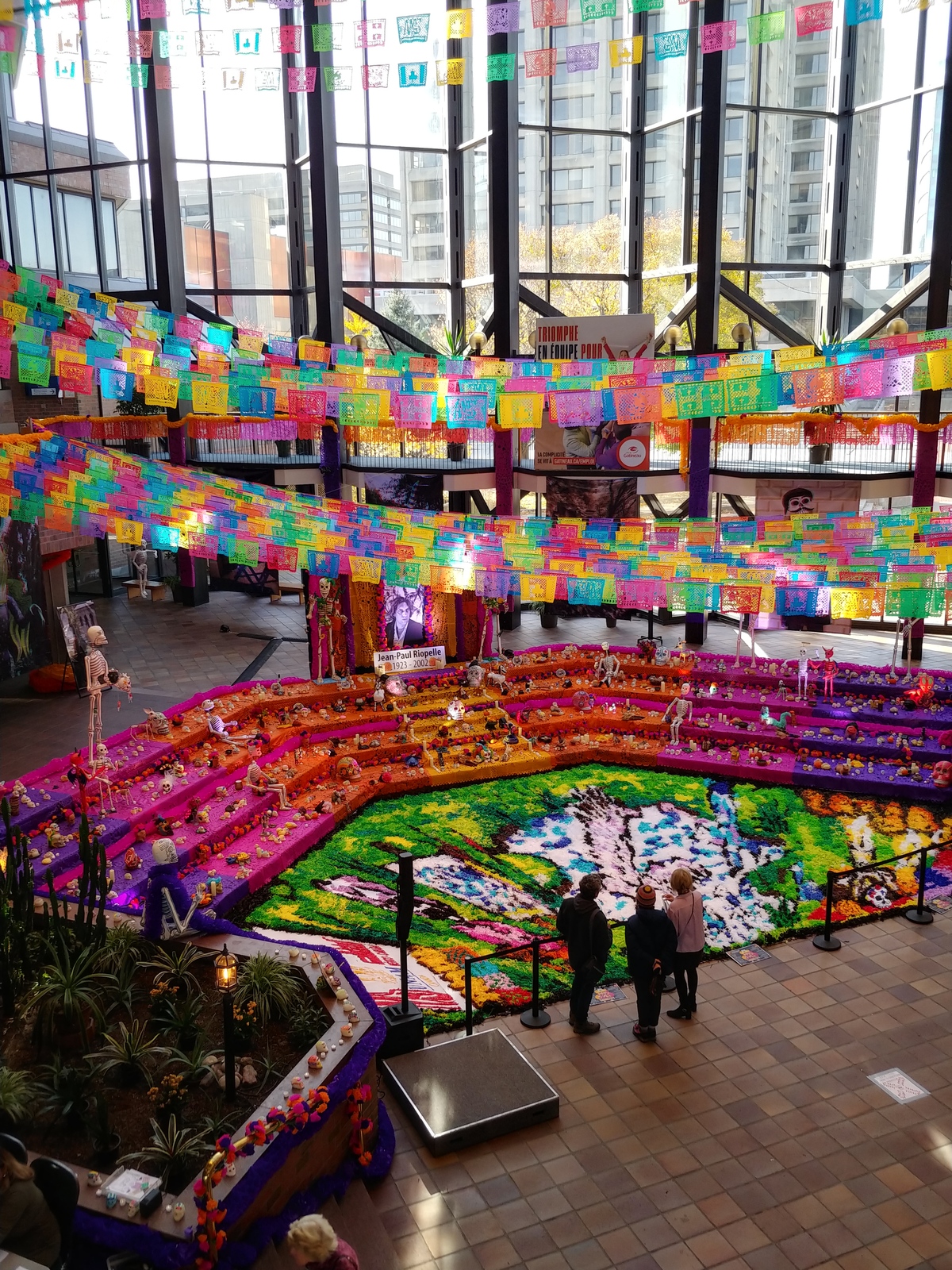
Day of the Dead altar commemorating Québec artist Jean Paul Riopelle at Maison du Citoyen
This image was taken by student Noémie Burrs while attending a Day of the Dead celebration at UNAM-Canada in Gatineau Quebec. The image features vibrant colours, patterns and textures surrounding an alter dedicated to late canadian artist, Jean Paul Riopelle. He is known internationally for pioneering "mosaic" style abstract paintings in the 1950s. -
Canadá Habla Español (Ottawa Chapter)
Canada Habla Español (CANHE) is a Canadian-based organization that operates in Manitoba, Saskatchewan, and Ontario - Ottawa, that encourages the preservation and promotion of the Spanish language. Their mission, here, in Ottawa, is to help expand access to Spanish-language education, while also celebrating the identity and traditions of Spanish speakers of the region. They actively support the development of Spanish-speaking communities across Canada and the preservation of the Spanish language.
It was founded by Ericka Aguilera, an active member and advocate of various Canadian-Hispanic communities, who was born in Mexico. With her are her co-founders, Luz Madroñera and Carolina Testa, from Colombia and Argentina respectfully.
CANHE regularly hosts celebratory and educational events across its seven different chapters, including their yearly Spanish Language Day celebration in April, where you will find a panoply of lectures, panels, and musical numbers to celebrate the Spanish language: all are welcome! They debuted this celebration in Ottawa last year at the Embassy of Spain in Canada, and it will henceforth be celebrated in Ottawa yearly.
They also host a “youngpreneur” program, which aims to provide students with alternative educational paths while helping them connect with the Spanish language and Hispanic heritage. These workshops, conferences, and events allow students to learn from different individuals in their community and develop key skills.
Follow their events and updates on the CANHE website and on their social media pages!