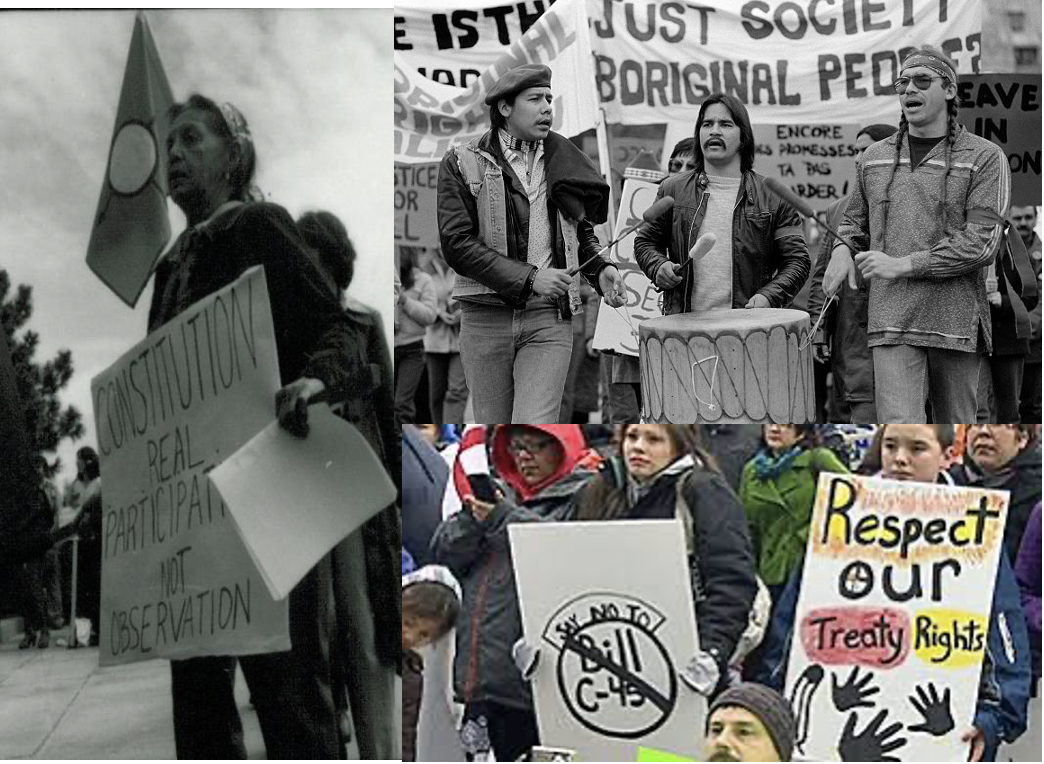
White Paper/Red Paper Exchange
The White Paper
In 1969 Minister of Indian and Northern Affairs Jean Chretien proposed the State of Government of the Government of Canada also known as the White Paper. Adopted under Pierre Trudeau's Liberal government, the White Paper became signature to the "Just Society" policy that Trudeau had envisioned for Canada.[1] In light of the Hawthorn report that had been published in 1966/67, the White Paper was proposed as the new Indian policy that was to guarantee "the right of Indian people to full and equal participation in the cultural, social, economic, and political life of Canada"[2]. The policy acknowledged the "legal and administration discrimination"[3] of Indian people in Canada under separate government systems and proposed a solution that would essentially equalize Indigenous populations by granting them Canadian citizenship. The policy argued that "all Indians should have access to all programs and services of all levels of government equally with other Canadians" [4] which was designed to appeal to the desires of Indigenous leaders and activists.
The White Paper's acknowledgment of discrimination towards Indigenous people in Canada demonstrated the historical failings of government policies towards Indians embodied in the Indian Act of 1876 [5]. However, the proposal of integrating Indigenous peoples into the general society of Canada as so-called "citizens" was less appealing to leaders and activists of these communities and was perceived as just another assimilative practice to deny Indigenous rights and assert Euro-centric dominant practices [6]. Despite the consultation of Aboriginal bands and leaders in the process of drafting the White Paper, the policy asserted a sense of ignorance towards treaty rights that protected the cultural practices of Indigenous communities and their governance. The language used in the White Paper itself on one hand denounced oppressive and discriminatory policies of the past but on the other still emphasized the need for government structure over Indian affairs and integration into Canadian society via citizenship.
Harold Cardinal and "The Unjust Society"
Harold Cardinal was a Cree chief, lawyer, author, and Indigenous activist during the 1970s until his death in 2005 [7]. Born in 1945, Cardinal grew up on Sucker Creek reserve in Alberta and was involved in Indigenous politics and activism for much of his life. Cardinal became the youngest president of the Indian Association of Alberta in 1968 and was actively involved in the movement against the White Paper in 1969 [8]. Cardinal remained leader of the IAA until 1977 and was actively involved in activism programs that sought to affirm Aboriginal Rights.
In 1969 Cardinal published "The Unjust Society" [9] a spin of Trudeau's vision for a "just society" that would perpetuate the assimilative processes of the Canadian government against Indigenous communities and undermined the importance of treaty rights. Cardinal asserted a political philosophy of honoring the importance of treaty rights that were negotiated a century prior. Cardinal, however, did argue for a sense of compatibility that he saw between Indian and Canadian citizenship [10]. Cardinal was a central figure in leading the resistance against the White Paper and presented his counterargument on behalf of the Indigenous people of Canada in parliament in June of 1970.
After Cardinal left the IAA, he took a break from provincial First Nations politics and took on a political career in the public services as the first Indigenous person appointed to be the director of Indian Affairs in Alberta [11]. His work on advocating against the White Paper proposal demonstrated the rise of political activism in the 1970s on a national scale.
This video gives a brief introduction to Harold Cardinal and his prevalence in Indigenous activism in the 1970s. This video background information on Cardinal and his involvement in Indigenous politics in Canada.
Video Source:
APTN News. "Harold Cardinal. National Aboriginal History Month. June 19, 2017.
https://www.youtube.com/watch?v=QFMyvJkt04w
The Red Paper
In 1970 the Indian Association of Alberta released Citizens Plus, also known as the Red Paper which argued against the White Paper and rejected its assimilative proposals. Harold Cardinal, leader of the IAA at the time, along with other Indigenous leaders drafted Citizens Plus as a way of defending Indigenous treaty and land rights as well the right to public services and self-determination [12]. The Red Paper included many ideas proposed in Cardinal's Unjust Society and became the official position of Aboriginal peoples and organizations like the National Indian Brotherhood [13], across the country.
The Red Paper was presented to Prime Minister Trudeau in parliament on June 3rd, 1970 in a dramatic display that incorporated traditional Indian dress and dancing as part of its presentation [14]. The Red Paper itself was an expression of Indigenous resistance against the White Paper proposals that were seen as assimilative and threatening to Indigenous rights and governance [15]. The White Paper reflected ignorance of the Trudeau government towards the actual concerns and demands of Indigenous leaders and their people. Thus, the Red Paper held strength both in the ideas it presented on paper but also in how it was addressed to the federal government in its elaborate delivery. The success of the Red Paper in denouncing the White Paper became fully recognized in 1971, as the Trudeau administration was forced to withdraw its proposal and was thereafter solidified with the affirmation of Indian title in 1973.
Sources:
[1] Elisabetta Kerr. "Pierre Trudeau’s White Paper and the Struggle for Aboriginal Rights in Canada: An Analysis of the Extent to which the White Paper was a Turning Point in the Struggle for Aboriginal Rights and Land Claims in Canada," The Great Lakes Journal of Undergraduate History 5 no. 1 (2017): 55.
[2] Statement of the Government of Canada on Indian Policy. Department of Indian and Northern Affairs. (1969)
[3] "White Paper/Red Paper," in Stolen Lives: The Indigenous people of Canada and the Indian residential schools, Facing History (2015).
[4] Statement of the Government of Canada on Indian Policy. Department of Indian and Northern Affairs. (1969)
[5] Leon Crane Bear, "The Contemporary Relevance of the Historical Treaties to Treaty Indian peoples," Active History (2015).
[6] "White Paper/Red Paper," in Stolen Lives: The Indigenous people of Canada and the Indian residential schools, Facing History (2015).
[7] Ian Getty, "Harold Cardinal," The Canadian Encyclopedia. May 15, 2011.
[8] Leon Crane Bear, "The Contemporary Relevance of the Historical Treaties to Treaty Indian peoples," Active History (2015).
[9] Harold Cardinal, The Unjust Society (Vancouver: Douglas & McIntyre, 2000).
[10] Alan Cairns, Citizens Plus: Aboriginal Peoples and the Canadian State (UBC Press, 2000): 68.
[11] Ian Getty, "Harold Cardinal," The Canadian Encyclopedia. May 15, 2011.
[12] Alan Cairns, Citizens Plus: Aboriginal Peoples and the Canadian State (UBC Press, 2000): 67.
[13] Ibid, 67-68.
[14] Leon Crane Bear, "The Contemporary Relevance of the Historical Treaties to Treaty Indian peoples," Active History (2015).
[15] Ibid.