Browse Items (218 total)
Sort by:
Terracotta Pig Rattle
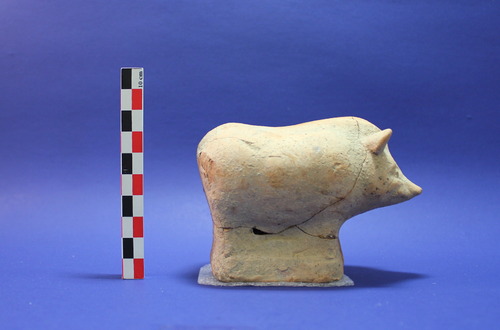
The lower portion of the pig is block-like and terminates in a base, defined on one side by a slight carination. The front shows more detail than the other three sides: the legs are cursorily differentiated and the face is naturalistic with…
Protome Jug
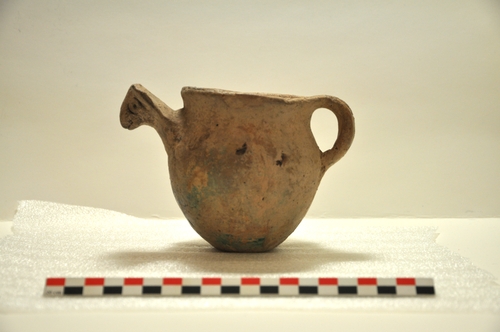
Shape: flat-based jug with single loop handle attached at rim and widest diameter of the body; the side opposite the handle is decorated with a protome of a ram, extending from just below the rim; the animal has a long neck and large eyes; the…
Coin
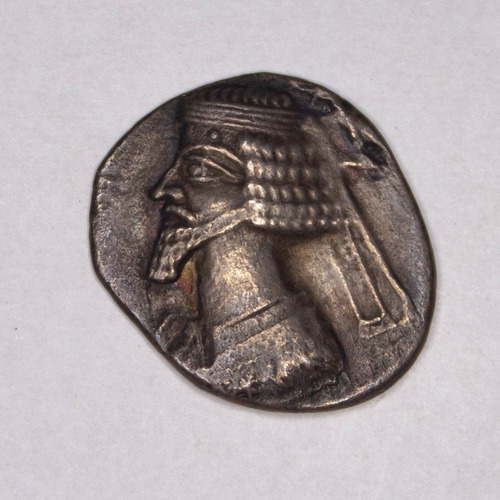
Oval in shape.
Obverse: Bust facing left, headdress, bearded.
Reverse: Figure seated right (?), surrounded by square border of characters.
Obverse: Bust facing left, headdress, bearded.
Reverse: Figure seated right (?), surrounded by square border of characters.
Coin
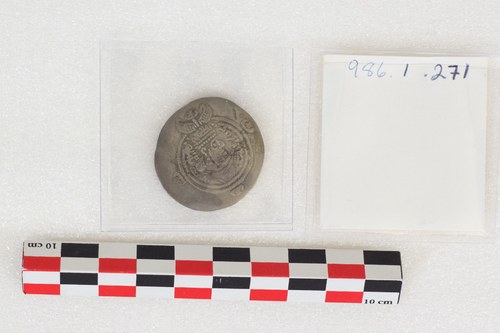
Oval in shape.
Obverse: Bust facing right, wearing headdress; two borders present at north, east, west, and south positions.
Reverse: Two figures standing facing forward with a column (?) in between them; three borders, same symbol as on obverse…
Obverse: Bust facing right, wearing headdress; two borders present at north, east, west, and south positions.
Reverse: Two figures standing facing forward with a column (?) in between them; three borders, same symbol as on obverse…
Oil Lamp
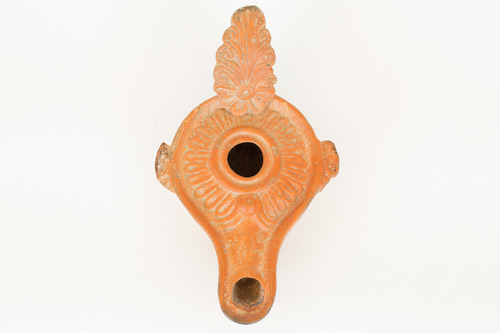
Colour: reddish brown. Clay. Round body with long nozzle; discus surrounded by a rim; concentric rings around filling-hole. One decorative knob on each side.
Discus iconography: pattern of petals that emanate from the filling whole and terminate…
Discus iconography: pattern of petals that emanate from the filling whole and terminate…
Painted Pyxis
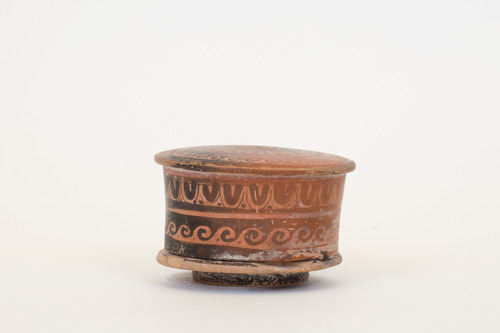
Small storage box for cosmetics, trinkets or jewelry. Black-glaze decoration on red ground; decorative friezes and solid horizontal bands encircle the exterior wall of lid; in the upper zone, an ogive pattern, beneath which is a narrow horizontal…
Friends of the MCA Club Logo
Logo for the Friends of the MCA Club
Kantharos
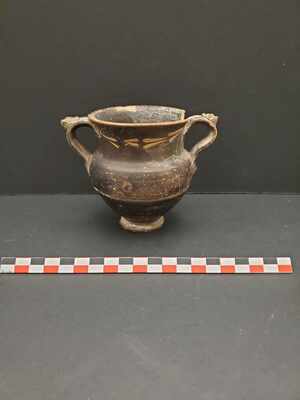
Ceramic material with dull black finish.
Olive leaf band painted between handles (Dionysiac connection).
Dramatic masks in relief at apex of both handles (Dionysiac connection).
Originally described as a kantharos but more closely resembles an…
Olive leaf band painted between handles (Dionysiac connection).
Dramatic masks in relief at apex of both handles (Dionysiac connection).
Originally described as a kantharos but more closely resembles an…
Oinochoe
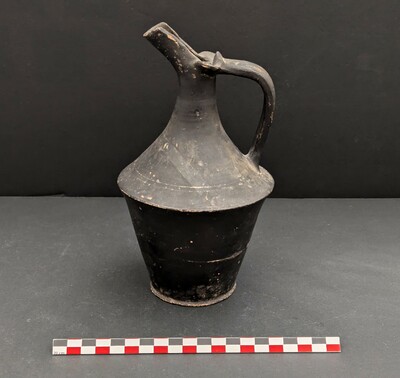
Black beaked
Samian Flask
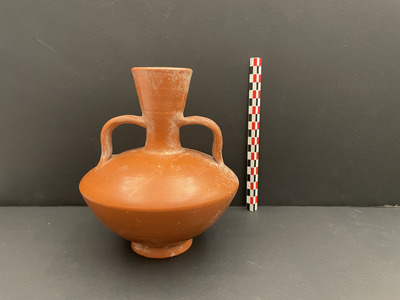
Samian, terra sigillata
Red/brown in colour.
Has more of a sharper curve, not as round.
No design on the outside, has a bit of a design on the handles, some well defined lines can be seen.
Lines around the neck can be found.
Some white/grey clay or…
Red/brown in colour.
Has more of a sharper curve, not as round.
No design on the outside, has a bit of a design on the handles, some well defined lines can be seen.
Lines around the neck can be found.
Some white/grey clay or…
Dish
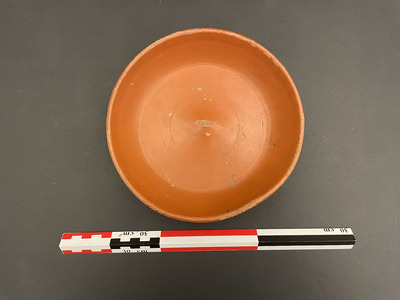
Dragendorf Form 18/31
Ceramic material with red gloss (terra sigillata)
Dish has warped lip - a second (?)
Originally sold as stampd by luventius
Illegible stamp
Foot Interior Has Sticker reads "CANTERBURY" VAUXHALL March 15, 1871 (Auction house)
Ceramic material with red gloss (terra sigillata)
Dish has warped lip - a second (?)
Originally sold as stampd by luventius
Illegible stamp
Foot Interior Has Sticker reads "CANTERBURY" VAUXHALL March 15, 1871 (Auction house)
Apulian red-figure lekythos
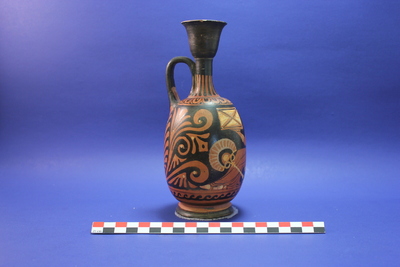
The artefact is a small lekythos painted in the red-figure style. Its mouth, handle and top-half of its neck are painted in black. The bottom-half of the neck has a pattern of descending vertical lines leading into an ogive pattern on the shoulder.…
Archaeology Day Event 2023
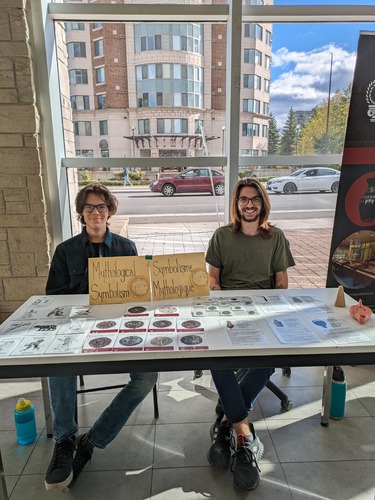
On October 12, 2023, the Museum and the student association AECRSA hosted Archaeology Day! The event brought together different interactive booths covering topics such as coin symbolism, Roman scripts, weaving and spinning; as well as local…
Donation of artefact 2022.1.1 by Robert Weir
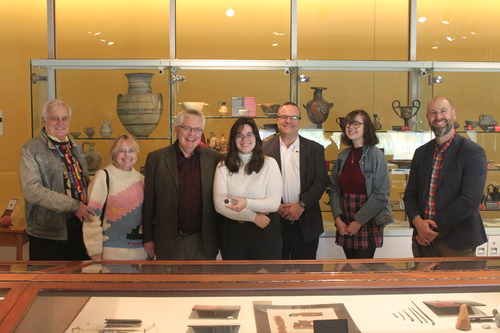
On Friday, October 14th, the University of Ottawa Department of Classics and Religious Studies hosted a lecture by Dr. Robert Weir from the University of Windsor. He presented his research on an ancient coin, which may have been minted at Stymphalos,…