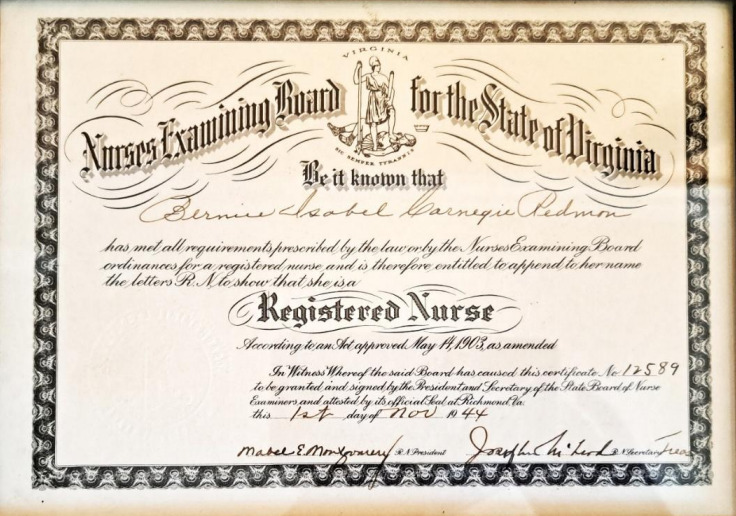
Bernice Redmon, as mentioned before, became the first Black Canadian Registered Nurse (RN) in 1945. Up until then, nurses of African descent mostly worked in their own communities, as possibilities for employment and education were very limited. Bernice's career experience is very interesting, as she became the first Black woman to become a RN. However, this was not easy for her, and she brings up many examples of racism in her field. She notes: "One thing that was very upsetting to the Black nurses… they usually had a head nurse in the operating room that was White. Now this didn’t make sense because we had well qualified [Black] nurses that could have been head nurse in the operating room." This is another example of discrimination in the nursing field, and the double standards when it came to Black nurses. However, the biggest challenge Bernice faced was when she moved to Sydney, Nova Scotia, where she became a RN. Obviously being the "first" something, is always difficult, and this was no acception, she reflects: “It wasn’t that they did not need nurses; it was the fact that they had never had a Black nurse before; it was just difficult accepting me. I went to see the medical officer of health who told me they needed nurses, but he would have to get his advice on whether to hire me from Halifax which was head office and told me to come back the following week. I went back; he hadn’t heard from Halifax. And he told me to come back again the second week, and I went back and then told me to come back again the third time and when I went back, and he hadn’t heard anything. . . I just decided he was giving me the run around.” Drawing on her experiene, we can see the difficulties Black women faced in employment.
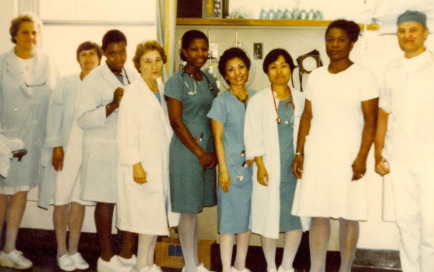
This is a picture of a few nurses working at the St. Michael’s Hospital. Judy Allen (in the middle), a Jamaican born nurse who came to the hospital in 1972 as a Registered Nurse. She recalls her experience in the workplace, that both patients and staff looked at her “differently”. She says: "When I came here and I saw people looked at me differently and I thought, Wow. I had never seen that before. [...] I would go to the bus and say good morning. Nobody answered. They would either put their head down or turn their head away. That’s one of the most dehumanizing things you can do to another human being." She was treated differently, isolated and ignored because of her skin colour. She also recalls that some patients would pull their hands away from her, and even doubt her skills and qualifications. She says, "When you speak up from a place full of caring and love, people know", she was a caring nurse and mentor, inspiring the next generation of Caribbean nurses at the hospital. Lisa Mendell, who started working at St. Michael's in 2007, she fondly remembers: “Judy taught me many skills and valuable lessons of compassion, authenticity and patience, which I hold so dear to my heart and helped to shape my nursing journey.” Allen changed attitudes about Black nurses in her patients through care and genuine human connection. Nurses like Judy were the ones changing patients' opinions on race one by one, and it is important to remember their work and contributions in the field.
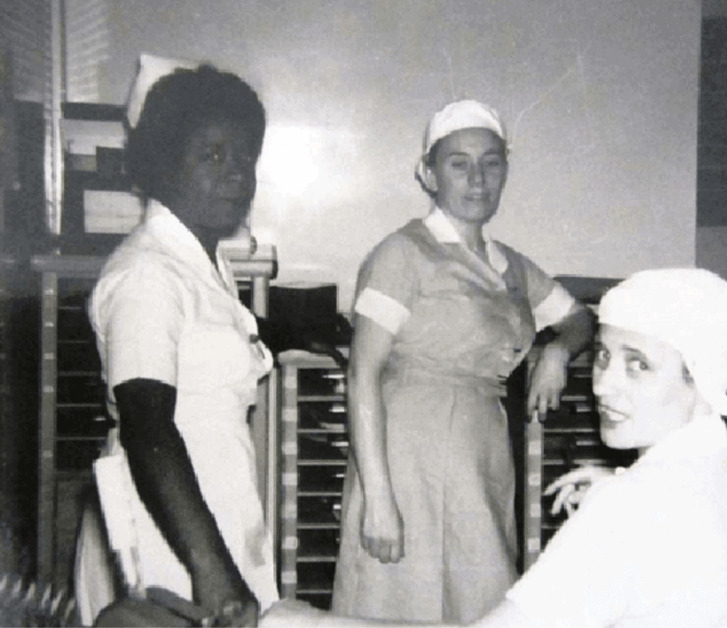
Lillie Johnson was born in Jamaica in 1922, received training there and in the UK. She came to Canada in 1960, receiving a BScN from the University of Toronto. She became the first Black director of public health in Ontario, again the fact that it took this long to have a Black director of public health is evidence of discrimination on its own. She became a prominent figure in healthcare, founding the Sickle Cell Association of Ontario. The picture shows her working with the Victoria Order of Nurses at St. Joseph's Hospital in Toronto, 1960-1963.