Browse Items (687 total)
Sort by:
Africville - Black Community - Unidentified Woman In Grocery Store [Matilda Newman].

A photograph of Matilda Newman inside her grocery and confectionary store in Africville, this image captures Newman within the context of the everyday rhythm of her work. She's standing in front of shelves stocked with the goods she would have been…
UNIA members
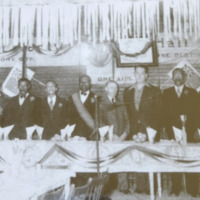
UNIA member meeting
Portrait of Marcus Garvey
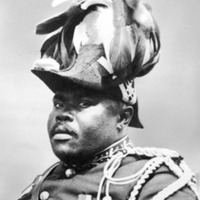
Founder of the UNIA, a movement for racial uplifting in areas like industrial and educational opportunities for Black people. Even though mainly in America, it took root in Canada around 1918-1920, with Glace Bay or Montreal being the first in…
UNIA Dues Cards
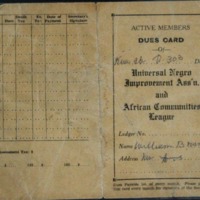
Due cards for active members of the UNIA. The UNIA in Glace Bay was a formal organization taking records of who came and when they came into the UNIA.
Blast Furnace Crew

- Both Black & white workers are present in this photo, which some could say means that they got along enough to take a photo all together or knowing that the higher-ups at DISCO were using their black workers to try and recruit more Black…
UNIA Brass Band

Reproduction of a newspaper article about the UNIA band on Laurier Street in Whitney Pier. Members are marching the street with instruments and banners in support of a movement advocating "Africa for the Africans." The UNIA was prominent among Black…
Menelik Hall

Menelik Hall—Sydney, Cape Breton. The hall was constructed between 1935 and 1936 by Black residents of Sydney. In the hall Marcus Garvey gave his "the work that has been done" speech in 1937 to members of the Sydney branch of the UNIA. This was…
Interview of Velma Iris Coward King by Stanley Grizzle

The pull toward opportunity grew even stronger through the work described by Velma Iris Coward King, whose efforts within the Ladies’ Auxiliary, (organizing plays, coordinating fundraisers, and raising money for scholarships), made Montreal…
Interview of Evelyn Braxton by Stanley Grizzle
As Black families arrived in Montreal seeking stability they had been denied elsewhere, the city’s developing community networks became an additional pull factor. Evelyn Braxton’s memories of the Ladies’ Auxiliary hosting cultural gatherings,…
Interview of Joseph Morris Sealy by Stanley Grizzle
Many Black families were pushed from their homes because of discrimination, limited schooling, and unstable jobs, creating a need to move somewhere with real economic security. Montreal became that destination because the railroad industry offered…