
Road to Recognition: Afro-Descendant Struggles and Victories in Brazil and Argentina
Narrated by Audrey Lacroix. Audio commentary for CLIP #8 – Evolution and Progress.
The legacies of Vargas and Perón continue to shape national identity and racial discourse in Brazil and Argentina. However, new movements, policies, and scholarship are challenging the racial exclusions embedded in these historical narratives.
Road to Recognition:Brazil
During the 1930s, Getulio Vargas was responsible for significant transformations in the country’s national identity. During the Estado Novo regime from 1937 to 1945, Vargas promoted forms of Afro-Brazilian cultural expression like carnival, as well as samba, elevating them as elements of national pride. However, these were sanitized expressions of the art form, produced to align with state narratives while repressing their significance within Afro-descendent communities in Brazil.
Despite increasing cultural acknowledgement, Afro-descendant peoples in Brazil continue to face systemic inequalities, such as lack of access to education, as well as limited employment and political opportunities (Williams, 2016). Cultural forms once suppressed, such as Candomblé and funk, continue to be criminalized or stigmatized, even as Black cultural expression is central to Brazil’s global image (Williams, 2016).
The Frente Negra Brasileira (FNB) was established in 1931 and quickly cemented itself as a primary institution in the fight for civil rights and the social integration of Afro-Brazilians. Meanwhile, the authoritarian nature of Vargas’ regime suppressed and stalled it and similar movements, slowing the progression to racial equality in Brazil. In the second half of the 20th century, there was a significant resurgence in Afro-Brazilian activism. This is when the first challenges to “racial democracy” were being presented. The Black press of Brazil served a crucial role in this instance. (Domingues, 2007)
By the early 21st century, the fruits of decades of activist labor became visible with significant policy advancements and affirmative action in the educational and employment sectors. The 2010 census allowed individuals to self-identify their race, a direct acknowledgment of the diverse racial composition present in Brazil. Challenges persist, however. In the 2022 census it was revealed that Afro-Brazilians continue to be underrepresented in the education sector as well as in formal employment. (Brazilian Institute of Geography and Statistics [IBGE], 2025)
Social movements have responded by contesting both the reality and the myth of racial democracy. Black consciousness activism, affirmative action policies in universities, and growing academic recognition of Afro-Brazilian history have begun to recenter Black identity as a political category, not just a folkloric one (Williams, 2016).
Road to Recognition: Argentina
Argentina’s racial narrative has been slower to shift. For most of the 20th century, the state denied the presence of Afro-Argentine populations altogether, a denial reflected in censuses, textbooks, and public institutions (Populism and New Nationalism, 2003). Only in 2010 did Argentina include a question on Afro-descendant identity in its national census, acknowledging the existence of a community long considered “disappeared.”
With Peron in the 1940s, race was brought back to the front of public consciousness in Argentina as non-whites from the inner rural country migrated to larger metropolitan cities like Buenos Aires. Though they faced discrimination at first, this mobilization opened the door to reworking racial stratification to build a more inclusive Argentina. Despite these advancements in social justice the Afro-descendant population of Argentina remained invisible in its national identity.
In the late 20th century, there were attempts to challenge the Black invisibility with organizations mobilizing to create events centered on exposing the experiences of the African diaspora in Argentina. For example, the creation of the Comité Argentino Latinoamericano contra el Apartheid (The Argentine Committee against Apartheid) in 1984, shortly after the restoration of the country’s democracy, was a step forward to amplifying the voices and experiences of Afro descendants in Argentina. This organization was also in part inspired by the black liberation movements within Brazil at the time (Anderson and Gomes, 2021)
By the early 2000s, the increased immigration of highly visible Afro-descendants could no longer be ignored. This led to the creation of organizations to serve their specific needs. From there, different conferences and events were created, allowing Afro-descendant peoples from across the county to organize and interact. These organizations helped create new legislation to officially recognize Afro-descendant populations. They also heavily contributed to the creation of new legislation to officially recognize Afro-descendant populations and create a legal framework for laws and policies that would condemn racism as a criminal offense (Anderson and Gomes, 2021).
“Many of these legislative acts were passed under the Fernández de Kirchner administration (2007–2015), like the 2015 Law No. 5.261 Against Discrimination, which provided a more comprehensive antidiscrimination policy, and the historic 2010 Argentine census, which restored the possibility of identifying as Afro-descendant.” (Anderson and Gomes, 2021)
“The reappearance of the category in the 2010 census after over a 120-year absence had been prompted by the World Bank’s landmark census 5 years prior. Though these gains were primarily symbolic, they helped fortify Black activism.” (Anderson and Gomes, 2021)
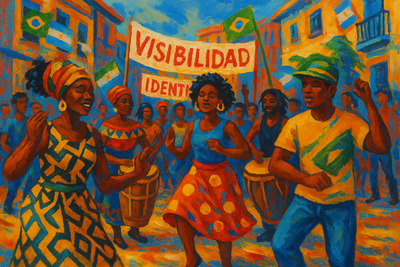
Afro-Latin American cultural celebration highlighting music, dance, and community expression.
This recognition has been driven by Afro-Argentine activists and scholars, who have worked to recover erased histories, advocate for cultural heritage protections, and demand public visibility (Populism and New Nationalism, 2003). However, the Peronist legacy of conflating social inclusion with racial inclusion continues to obscure the specific barriers faced by Afro-descendants in Argentina (James, 2001).