
Next Steps and Bibliography
Next Steps
While Brazil and Argentina have introduced initiatives aimed at addressing racial inequality, the structural legacies of exclusion remain deeply entrenched. Disparities in education, employment, and political representation continue to shape the lived experiences of Afro-descendant populations, revealing the limitations of symbolic inclusion and recognition without redistribution (James, 2001; Williams, 2016; Freire et al., 2018). Although reforms such as the inclusion of racial identity questions in national censuses, anti-discrimination legislation, and public cultural campaigns signal progress, they have not yet translated into substantive material change (CEPAL, 2020; Oxford Research Encyclopedia of Politics, 2022; IBGE, 2022). Historical erasure, limited access to quality public services, and the continued absence of Afro-descendants in policymaking roles reflect how deeply racial hierarchies remain embedded in state structures (Freire et al., 2018; James, 2001; Williams, 2016).
In many cases, initiatives claiming to support inclusion are adopted without sufficient institutional resources, community consultation, or enforcement mechanisms (CEPAL, 2020; Oxford Research Encyclopedia of Politics, 2022). As a result, Afro-descendant populations continue to experience not only socioeconomic marginalization but also restricted access to full citizenship and national belonging. Without structural reforms that are grounded in equity, accountability, and direct participation, efforts at racial inclusion risk reproducing the very inequalities they aim to undo (Freire et al., 2018; Williams, 2016).
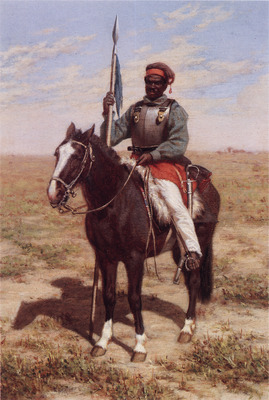
19th-century painting of a Black cavalry lancer from the era of Fructuoso Rivera, highlighting Afro-descendant military presence in Latin America. Juan Manuel Blanes, via Wikimedia Commons.
In Brazil, despite the myth of racial democracy, Afro-Brazilians remain overrepresented among the poor and underrepresented in government, higher education, and private sector leadership (Williams, 2016; IBGE, 2022). Cultural practices such as samba and capoeira are celebrated as national symbols but are often stripped of their political roots and commercialized without benefiting the communities that created them (Freire et al., 2018). In Argentina, Afro-descendants have long been erased from official discourse, and only recently, with the 2010 census and anti-discrimination measures such as Law No. 5.261, has the state begun to acknowledge their presence (Populism and New Nationalism, 2003; Oxford Research Encyclopedia of Politics, 2022). Yet these legal and statistical recognitions have not translated into comprehensive policy shifts (James, 2001).
Moving forward, scholars and activists identify several actionable priorities. First, national education systems must incorporate Afro-descendant histories into curricula at all levels. Doing so not only corrects erasure but also reshapes dominant narratives about citizenship and belonging (Freire et al., 2018; CEPAL, 2020).
Second, anti-racist legislation must be reinforced with institutional mechanisms for enforcement. While laws exist, their impact is limited without monitoring bodies and clear accountability procedures for addressing systemic discrimination (Oxford Research Encyclopedia of Politics, 2022).
Third, greater investment is needed in Black-led organizations and cultural institutions, which play a crucial role in advocating for racial equity and preserving community heritage (Freire et al., 2018; James, 2001).
Fourth, data collection practices must be improved. Continued support for racial self-identification in national censuses and targeted indicators related to health, income, and education are necessary to craft responsive, evidence-based policy (CEPAL, 2020; IBGE, 2022).
Lastly, representation must be institutionalized, not only through symbolic appointments but via long-term strategies for increasing Afro-descendant participation in policy development and governance structures (Freire et al., 2018; Williams, 2016). Together, these interventions shift the conversation from inclusion as recognition to inclusion as redistribution. Addressing racial inequality in Brazil and Argentina will depend not on rhetorical change, but on structural commitments backed by data, law, funding, and political will (CEPAL, 2020; Oxford Research Encyclopedia of Politics, 2022).
Conclusion
In conclusion, both Argentina and Brazil share unique histories when comparing the Afro-descendant experiences in both nations post-colonization. Brazil is rich with diversity while still riddled with inequality while Argentina has somehow erased an entire ethnic group from their population. The policies and social culture set in place by Getulio Vargas and Juan Domingo Peron significantly shaped the current demography of both countries respectively and were major actors in setting the tone for Afro-descendant peoples in the region. Brazil and Argentina’s Afro-descendant experiences are stark in contrast as elaborated upon earlier which we have seen can be attributed to each country’s influential leadership at the time. Thank you for joining us through our comparative analysis of Afro-descendant populations in Argentina and Brazil throughout such a transformational time in Latin American history.
Bibliography
Anderson, J., & Gomes, P. (2021). Blackness, Race, and Politics in Argentina. Oxford Research Encyclopedia of Politics. https://oxfordre.com/politics/view/10.1093/acrefore/9780190228637.001.0001/acrefore-9780190228637-e-1703.
Andrews, G. R. (1980). The Afro-Argentines of Buenos Aires 1800-1900. The University of Wisconsin Press. https://d-scholarship.pitt.edu/21145/1/31735066979950_optimized.pdf
Andrews, G. R. (1989). Los Afroargentinos de Buenos Aires. Ediciones de la Flor.
Andrews, G.R. (2004). Afro-Latin America: Black Lives, 1600–2000. Harvard University Press.
Andrews, G. R. (2010). Blackness in the White Nation: A history of Afro-Uruguay. University of North Carolina Press.
Brea, J. A. (2003). Population Dynamics in Latin America. Population Bulletin, 58(1) https://ccp.ucr.ac.cr/cursos/icamacho/public_html/sociopob_II_03/contenido/dinala.pdf
Central Intelligence Agency. (2025). Argentina. The World Factbook. https://www.cia.gov/the-world-factbook/countries/argentina/#people-and-society
CEPAL. (2020). Afrodescendent populations in Latin America: Towards a framework of inclusion. Economic Commission for Latin America and the Caribbean. https://www.cepal.org/en/publications/45665.
Chamosa, O. (2008). Indigenous or Criollo: The Myth of White Argentina in Tucumán’s Calchaquí Valley. Hispanic American Historical Review, 88 (1): 71–106.https://read-dukeupress-edu.proxy.bib.uottawa.ca/hahr/article/88/1/71/35539/Indigenous-or-Criollo-The-Myth-of-White-Argentina
Domingues, P. (1970, January 1). Movimento Negro Brasileiro: Alguns Apontamentos históricos. Tempo. https://www.scielo.br/j/tem/a/yCLBRQ5s6VTN6ngRXQy4Hqn/?lang=pt
Elena, E. (2011). Dignifying Argentina: Peronism, citizenship, and mass consumption. University of Pittsburgh Press.
Elena, E. (2017). Argentina in black and white: Race, Peronism, and the color of politics, 1940s to the present. In P. Alberto & E. Elena (Eds.), Rethinking race in modern Argentina (pp. 77–103). Cambridge University Press.
Fausto, B. (2017). A Concise History of Brazil. Cambridge University Press.
Freire, G., Díaz-Bonilla, C., Schwartz, S. O., Soler López, J., & Carbonari, F. (2018). Afro-descendants in Latin America: Toward a Framework of Inclusion. World Bank Group. https://documents1.worldbank.org/curated/en/896461533724334115/pdf/129298-7-8-2018-17-29-37-AfrodescendantsinLatinAmerica.pdf.
Freire, M. V., dos Santos, J. M., & Leite, J. (2018). Políticas públicas e a população negra: Educação, saúde e segurança pública. EDUFBA.
Garguin, E. A. (2007). “Los Argentinos Descendemos de los Barcos”: The Racial Articulation of Middle Class Identity in Argentina (1920–1960). Latin American Perspectives, 34(6), 38–56. https://doi.org/10.1177/0094582X07308118
Geler, L. (2010). Andares negros, caminos blancos: Afroporteños, estado y nación. Prohistoria Ediciones.
Gomes, I. (2023). Brazil has 1.3 million quilombolas in 1,696 municipalities. IBGE. https://agenciadenoticias.ibge.gov.br/en/agencia-news/2184-news-agency/news/37488-brazil-has-1-3-million-quilombolas-in-1-696-municipalities
Gomes, J. (2023). Quilombola Communities and Demographic Trends in Contemporary Brazil. IBGE.
Grimson, A. (2017). Raza y clase en los orígenes del peronismo: Argentina, 1945. Desacatos, 55, 110–127. https://doi.org/10.29340/55.1807
IBGE. (2022). Censo demográfico 2022: Características étnico-raciais da população. Instituto Brasileiro de Geografia e Estatística. https://www.ibge.gov.br
IBGE. (2022). Proportion of population with complete higher education increases from 6.8% in 2000 to 18.4% in 2022. Instituto Brasileiro de Geografia e Estatística. https://agenciadenoticias.ibge.gov.br/en/agencia-news/2184-news-agency/news/42748
INDEC. (2022). Censos nacionales de población 1895-2022. Instituto Nacional de Estadística y Censos. https://www.indec.gob.ar
James, C. L. R. (2001). The struggle for recognition: The politics of race and the visibility of Afro-descendants in Argentina and Brazil. In T. G. Andrews & C. A. Harnecker (Eds.), Race and Nation in Modern Latin America (pp. 153–175). University of North Carolina Press.
James, D. (2001). Perón and the people. In The Argentina Reader (pp. 274–294). Duke University Press.
Karush, M. B. (2004). Culture of Class: Radio and Cinema in the Making of a Divided Argentina, 1920–1946. Duke University Press.
Karush, M. B. (2016). Musicians in Transit: Argentina and the Globalization of Popular Music. Duke University Press.
Klimanova, O., Naumov, A., Greenfieldt, Y., Prado, R. B., & Tretyachenko, D. (2017). Regional Trends of Land Use and Land Cover Transformation in Brazil in 2001-2012. Geography, Environnement, Sustainability, 10(4). https://ges.rgo.ru/jour/article/view/353
Oliveira, A., et al. (2014). Social inequality in Brazil: Afro-descendants in Maranhão. IBGE Bulletin.
Oliveira, B. L., Silva, A. M., Silva, R. A., & Thomaz, E. B. (2014). Racial inequalities in the socioeconomic, demographic and health conditions of elderly from Maranhão State, Legal Amazon, Brazil: a population-based study. Acta Amazonica, 44(3), 335-344. https://www.scielo.br/j/aa/a/LyC9LFbYJn5SvCWKV3JcDcH/?format=pdf&lang=en
O’Neill, A. (2024). Population of Argentina from 1800 to 2020, Statistica. https://www.statista.com/statistics/1066826/total-population-argentina-1800-2020/
O’Neill, A. (2024). Population of Brazil from 1800 to 2020, Statistica. https://www.statista.com/statistics/1066832/population-brazil-since-1800/
Otero, H. (1997). Boletín del Instituto de Historia Argentina y Americana, (16/17), 136–139.
Oxford Research Encyclopedia of Politics. (2022). Afro-Argentines and the Struggle for Racial Justice in Argentina. Oxford University Press. https://oxfordre.com/politics/view/10.1093/acrefore/9780190228637.001.0001/acrefore-9780190228637-e-1703.
Oxford Research Encyclopedia of Politics. (2022). Afro-descendants and the politics of recognition in Latin America. Oxford University Press. https://oxfordre.com/politics/
Plotkin, M. (2003). Manana es San Perón: A cultural history of Peronism in Argentina. SR Books.
Poppino, R. (n.d.). Getúlio Vargas. Encyclopædia Britannica. https://www.britannica.com/biography/Getulio-Vargas
Populism and New Nationalism. (2003). Afro-Argentines and the whitening of national identity. In J. Rockwell (Ed.), Cultural Politics in Latin America (pp. 81–97). Duke University Press.
Populism and New Nationalism. (2003). In The Argentina Reader (pp. 269–273). Duke University Press.
Reed, K. (2020). Afro-descendant citizenship in Latin America: Patterns of exclusion and the struggles for rights. Latin American and Caribbean Ethnic Studies, 15(2), 123–145. https://doi.org/10.1080/17442222.2020.1751057
Rocha, Z. L., & Aspinall, P. J. (2020). The Palgrave international handbook of mixed racial and ethnic classification. Palgrave Macmillan. https://books.scholarsportal.info/uri/ebooks/ebooks5/springer5/2020-01-06/1/9783030228743
T. Skidmore. (1993). Black into white: race and nationality in Brazilian thought: with a preface to the 1993 edition and bibliography. Duke University Press. https://doi.org/10.1215/9780822381761
Smith, P. H. (1969). Social Mobilization, Political Participation, and the Rise of Juan Peron. Political Science Quarterly, 84(1). https://doi.org/10.2307/2147045
Solomianski, A. (2003). Identidades secretas: La negritud Argentina. B. Viterbo Editora.
United Nations. (2024). World Population Prospects: The 2024 Revision, Department of Economic and Social Affairs, Population Division. https://population.un.org/wpp/
Wainer, L. E. (2023). The City of Buenos Aires in the Censuses of 1778 and 1810. Population of Buenos Aires, 7 (11). https://www.redalyc.org/pdf/740/74012783008.pdf
Williams, D. (2016). Vargas Era and the Politics of Cultural Production, 1930–1945. Oxford Research Encyclopedia of Latin American History.
Williams, E. (2016). Racial inequality and the myth of racial democracy in Brazil. Latin American Research Review, 51(1), 68–86. https://doi.org/10.1353/lar.2016.0011.