
Arrowheads
The bow and arrow is a weapon that has been used by humanity for tens of thousands of years. Until the invention and weaponization of gunpowder, it was the main method of attacking from a distance. Over the millennia, the design of the arrowhead was iterated on and improved, giving rise to many different design philosophies that augment its ability to kill.
The shape and material of an arrowhead affect the arrow’s flight trajectory, weight, and damage potential. Observing the design of the arrowhead can tell us about how it may have been used in an ancient battle.
Wide blades and the presence of barbs or spurs made arrows especially effective at damaging flesh, while narrower arrows were specialized in piercing armour and clothing. Light arrowheads were specialised for long-distance volleys, while heavier arrowheads were optimized for short-range attacks.
The way the arrowhead connects to the shaft also affects the arrow’s strength and resistance to damage. Some arrowheads have a projection known as a tang, which is inserted into a hollow shaft. Later, arrowheads were made with a socket that allowed the shaft to be inserted into the metal piece instead. This provided greater structural resistance on impact.[1]
The material used as an arrowhead ranged greatly across early human history, from stones and bone to flint and copper. Bronze became the dominant material until the end of the Bronze Age, when iron became more prominent due to its abundance and strength, as well as innovations in iron casting technology allowing for easier mass production of arrowheads to equip the growing sizes of armies seen in the Iron Age.[2]
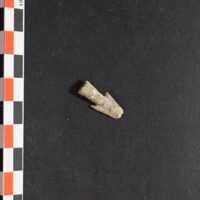
Arrowhead (995.14.4)
Here is a good example of an arrowhead designed with barbs. This arrow was likely designed to pierce cloth and flesh, and made to be more painful to remove once struck.
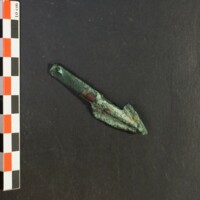
Arrowhead (990.5.1.1)
This is a clear example of a tanged arrowhead. The rectangular protrusion from the arrowhead would be inserted into a hollow wood shaft, creating an arrow. This arrowhead is also quite large in comparison to the other arrowheads, making this likely to be designed for short distance shots.
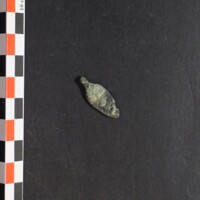
Arrowhead (990.5.1.7)
This is an example of a bilobate arrowhead, meaning the shape has one line of symmetry along its long axis. Note the difference in size compared to the above arrowhead, indicating that this arrow was meant for long distance.
Sources
[1] Malloy, A. 1993. Ancient and Medieval Art and Antiquities XXIV: Weapons. South Salem: Alex G. Malloy, Inc. 4-9.
[2] Gottlieb, Y. 2004. "The Weaponry of the Assyrian Attack." The Renewed Excavations at Lachish: 1973-1994 4: 1907-1969.