
Sling bullets
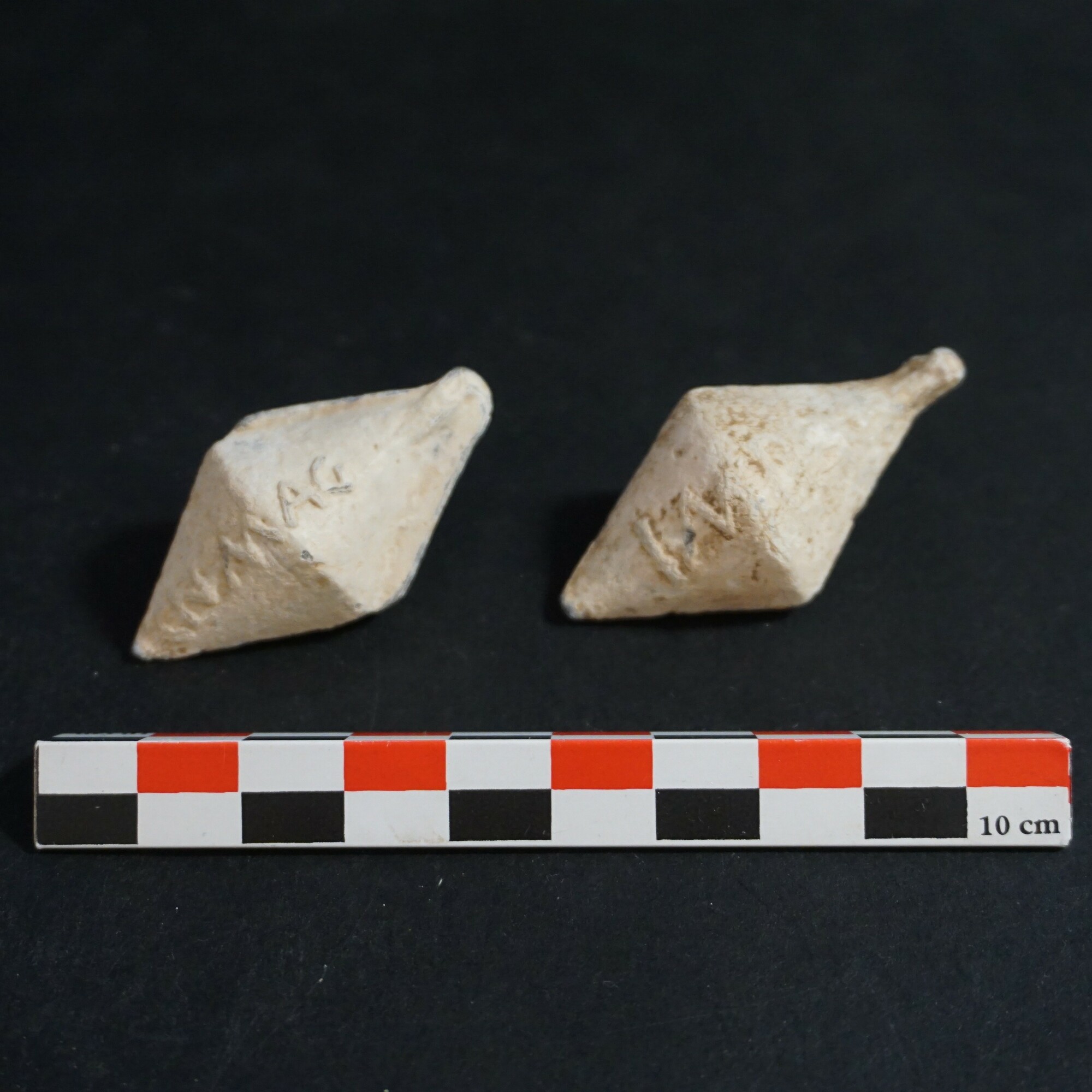
These small projectiles, known in Latin as glandes, were used in hunting or in battle, and could make quite the impact. Serving a function similar to archery, they were thrown from a corded string, and are estimated to have a maximum range of about 350 meters.
Usage of the sling and bullet as a missile weapon spans thousands of years, with evidence of its use seen in archaeological records across Greece and Anatolia dating to the Bronze Age.[1] Its greatest strength was its simplicity, being a long cord or strap with a pocket for ammunition, which was spun in a circle by the slinger and then launched at a target. The material of the bullet evolved from river stones and dried clay to cast metal as technology progressed.[2]
Sling bullets were used throughout the ancient Mediterranean and were initially made of stone or clay. The bullets pictured here are made of lead, the heaviest metal found in abundance in the Earth’s crust. Its toxic properties were not as well known to the Romans as it is to modern humans, so its uses included bullets as well as plumbing.
(Fun fact: We get our word "plumbing" from the Latin name for lead, plumbum!)
From our documentation, these two bullets were likely to be from the Battle of Munda in 45 BCE. This was the final major battle fought between the forces of Julius Caesar and the sons of Pompey in the civil war that broke apart an already cracking Roman Republic.
Lead bullets were sometimes inscribed with the names of magistrates or commanders, as well as insults and rude phrases or images of lightning bolts. The bullets in our collection have inscriptions with the letters CN MAG/IMP, which can be read as “Gnaeus Pompeius Magnus Imperator,” naming either Pompey the Great, the then deceased leader of the opposition against Caesar, or his son, also named Pompey the Great.
Sources
[1] Foss, C. 1975. "Greek Sling Bullets in Oxford." Archaeological Reports 21 (1974-1975): 40-44.
[2] Tuck, S. 1999. ""Ouch!" Inscribed Greek Sling Bullets in Missouri." Annual of the Museum of Art and Archaeology 33: 15.