
Javelin point
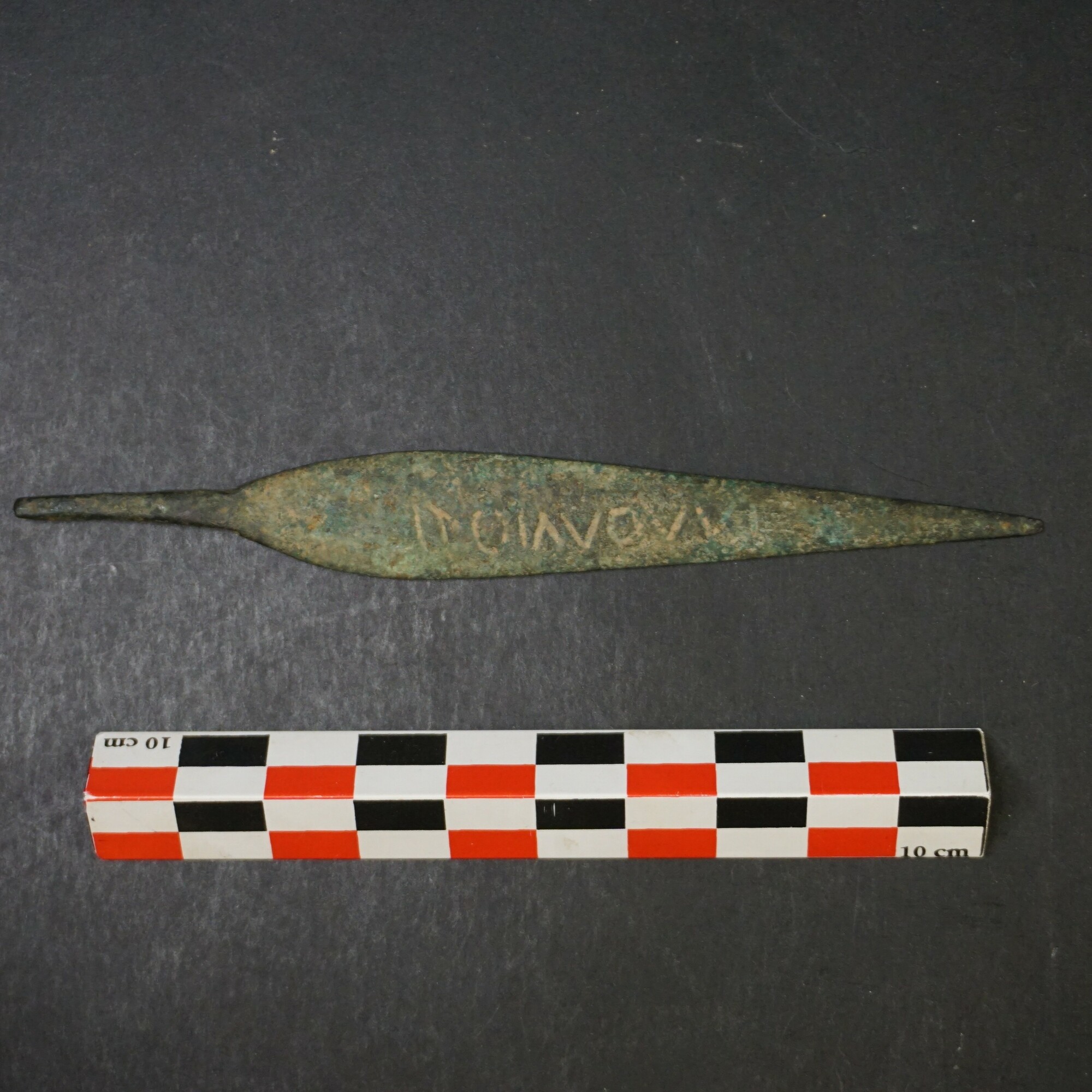
In contrast to spears – which were used for thrusting at close-range targets – javelins were used for throwing. They were shorter in length and designed with smaller tips.[1] The smaller size of this blade therefore means that it was probably used as a javelin point. It bears an inscription in dialectical Greek which has been translated as “to make dead”.
In the Bronze Age, javelins were used as missile weapons thrown from a chariot. They have been found in late Bronze Age and early Iron Age sites in Greece buried alongside warriors, and were most popular between the 10th and 8th centuries BCE.[2]
The use of javelins by soldiers continued into the Classical and Hellenistic Ages in Greece and Rome, where the technology was perfected. The legionnaries of the Roman Empire used a javelin design called the pilum, which had a narrow iron tip and a wooden shaft designed to bend on impact, making it unusable for anyone on the receiving end.[3] In addition to warfare, the art of the javelin throw was practiced at the Olympic games in Greece as early as 708 BCE, where they competed for longest thrown distance and accuracy. Accuracy with the javelin was tested by throwing the spear at round targets from horseback.[4]
Javelins fell out of use in the Middle Ages and beyond, likely due to its growing ineffectiveness against innovations in armour technology. Javelins need to be lightweight in order to be thrown, and thus need to be small, which renders them ineffective against chainmail and plate armour seen in the 10th to 16th centuries CE. Javelins did, however, remain in use as hunting weapons. The classic bow and arrow eventually fully replaced the javelin as the ranged weapon of choice due its superior portability, deadliness, stealth capabilities, and range.[5]
Sources
[1] d’Amato, R. 2016. "Arms and Weapons." In A Companion to Science, Technology, and Medicine in Ancient Greece and Rome, edited by G. Irby. Hoboken: John Wiley and Sons. 806.
[2] d'Amato 2016, 802.
[3] d'Amato 2016, 811.
[4] Dohrenwend, R. 2007. "The spear: an effective weapon since antiquity." Journal of Asian Martial Arts 16: 17.
[5] Dohrenwend 2007, 18.