
Spearheads
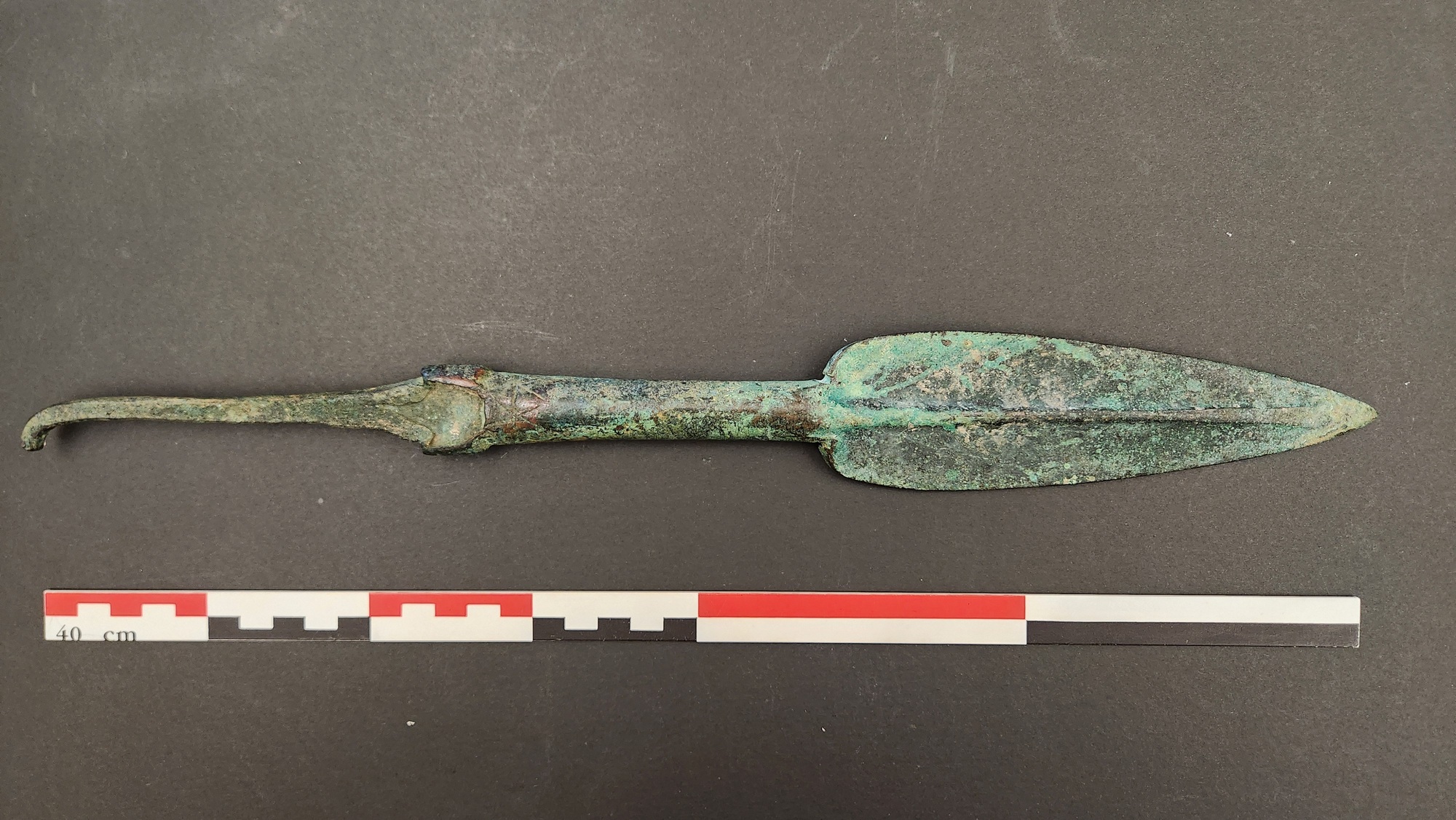
Bronze Spearhead (979.7.11)
This spearhead is most characterised by its striking greenish colouration. It is a symptom of bronze disease, the process by which bronze corrodes over time in the presence of moisture.
This spearhead also stands out due to its long and hooked tang (the projection at the end) along with its leaf-shaped blade and prominent midrib. This tang would be inserted into a hollow slot of a wooden staff for use as a spear. The long tang likely helped make the weapon more stable.
Based on similar examples of bronze spears found at auction sites and existing literature, this spearhead is likely a grave good from the late Bronze Age or early Iron Age, from western Iran.[1]
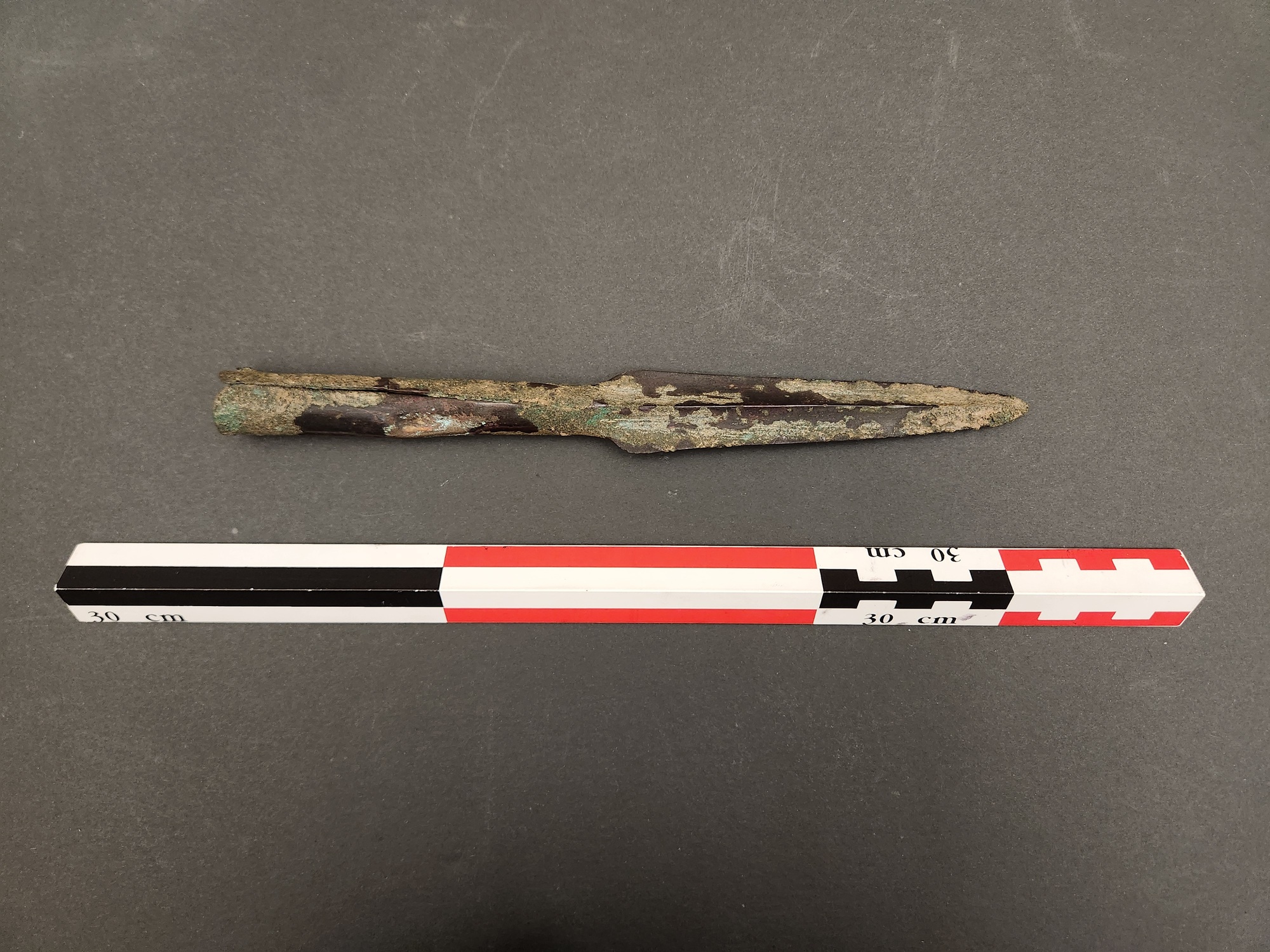
Bronze Spearhead (L.05.02.17)
This is another example of a bronze spearhead. However, note the difference in corrosion intensity and design philosophy. The above bronze spearhead has a wide leaf-shaped blade, while this spearhead is slender, and contains a socket instead of a tang.
The design resembles the tip of a Macedonian sarissa, the weapon of choice for the infantry and cavalry of Philip II of Macedon in the 4th century BCE. The sarissa was a huge innovation in battlefield technology and played a part in Philip conquering all of Greece, which had never been done before.
The source of the success of the sarissa was its great length. At the time of Alexander’s rule, the shaft of a sarissa ranged from 15 to 18 feet long.[2] This allowed mounted lancers to deal fatal damage to hoplite formations from a distance, negating the effectiveness of the existing style of hoplite warfare that had persisted in Greece for centuries. Like their Greek opponents, Macedonian soldiers would also form phalanxes, and by positioning their sarissae in a layered formation, they could become a formidable force. The length of the shaft required that a weight be added to the butt of the weapon in order to balance its weight, serve as an anchor when set down, and to be a secondary weapon in case the primary spearhead was broken off.
The material of the spear itself also contributed to its success. According to Arrian, during Alexander’s conquest of the Persian Empire, the Macedonian spear-shafts were made of cornel-wood, also known as the Cornelian cherry (Cornus mas).[3] Its exceptional hardness and elasticity made it ideal for shafts of sarissae as well as javelins and bows.[4]
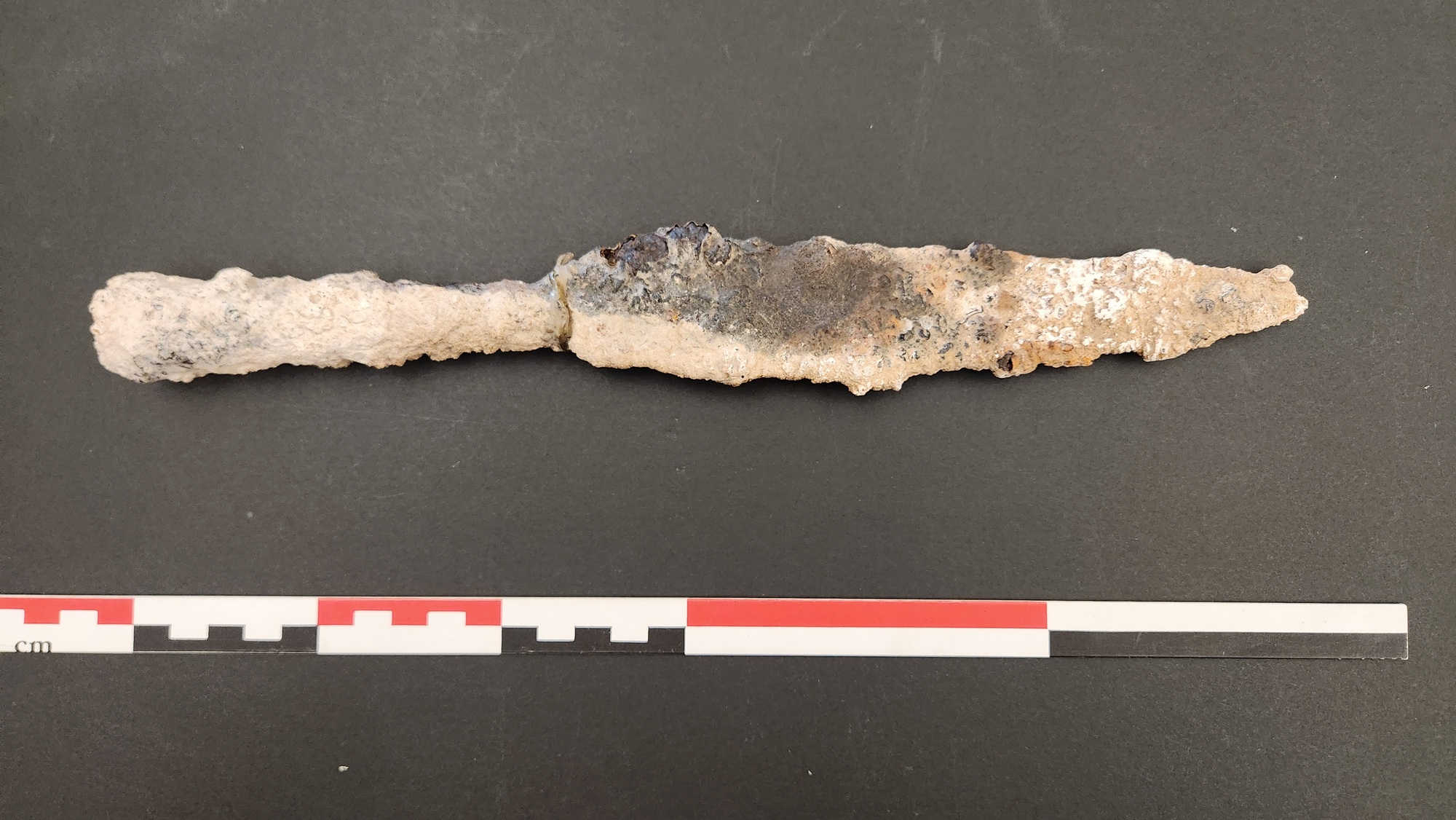
Iron Spearhead (2014.5.22)
Like the bronze spearhead above, this one has a socket so that a staff could be inserted into it rather than the spearhead being inserted into a staff. This method of attachment would have made the spear sturdier and less likely to break on impact.
This artefact is heavily encrusted, suggesting that it may have been buried in a wet environment.
Sources
[1] Modarress, M. 2017. "The Lure of the Luristan Bronzes: A Discussion on the Collecting and Plunder of Archaeological Heritage." Finskt Museum 124: 50-75.
[2] Markle, M. 1977. "The Macedonian Sarissa, Spear, and Related Armor." AJA 81: 323-339.
[3] Arr. Anab. 1.15
[4] Markle 2017, 324.