
Marble with Graffito
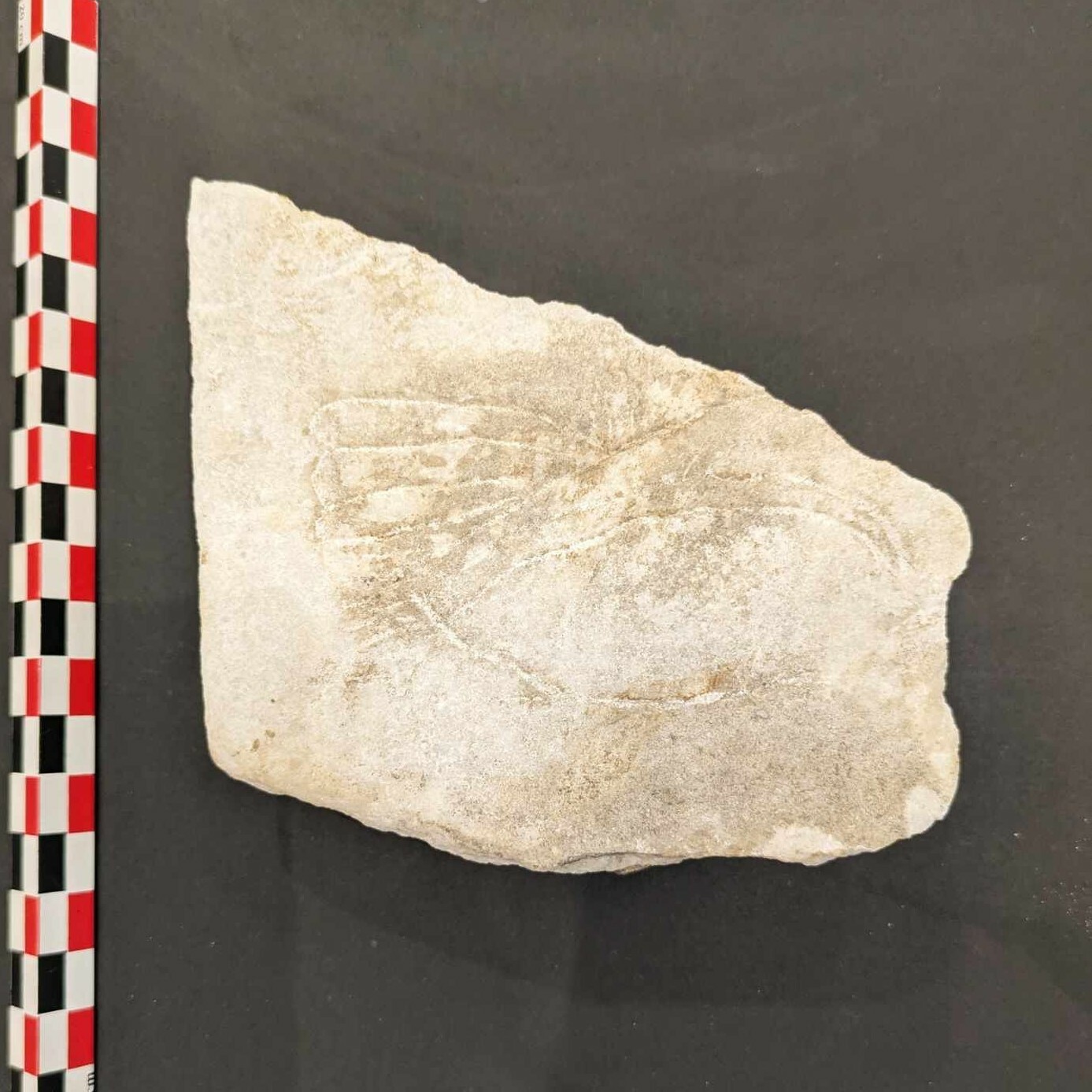
Some features of ancient architecture were unintended by its builders. This piece of marble is an example of an ancient graffito. In an archaeological context, a graffito (plural graffiti) is an ancient man-made marking made in a public area.[1] The purpose of graffiti can range widely, and we can learn more about day-to-day life in ancient society from these than we can from ancient historians alone.
Ancient graffiti can contain messages inscribed for political purposes, such as during a local election. They can also be for personal purposes, such as messages from an individual to their neighbour. Many examples of graffiti like this have been uncovered in Pompeii and Herculaneum, which are cities in Italy that were preserved in stasis under ash for millennia as a result of the eruption of Mount Vesuvius.
Our example of a graffito is on a piece of marble, reportedly found in the Catacombs of Priscilla in Rome. Even with this provenance, it is challenging to decipher what the drawing is depicting and its meaning. From its shape it could resemble a dove or a fish, two animals that are deeply symbolic to the early Christian faith. It may also be a phoenix, since the Catacombs of Priscilla is known to have frescos of the mythological creature.[2]
The identity of this ancient doodle offers a fun mystery that has thus far gone unsolved.
Sources
[1] Ralph, J. 2014. "Graffiti Archaeology", Encyclopedia of Global Archaeology. New York: Springer. 3102.
[2] Kardis, M., and Tlučková, D. 2022. “The Symbol of the Phoenix in the Catacombs of Priscilla in Rome and Its Transformation in Early Christianity.” The Biblical Annals 12: 65-88.