
Helios Figurine
Ritual Figurines and Idols
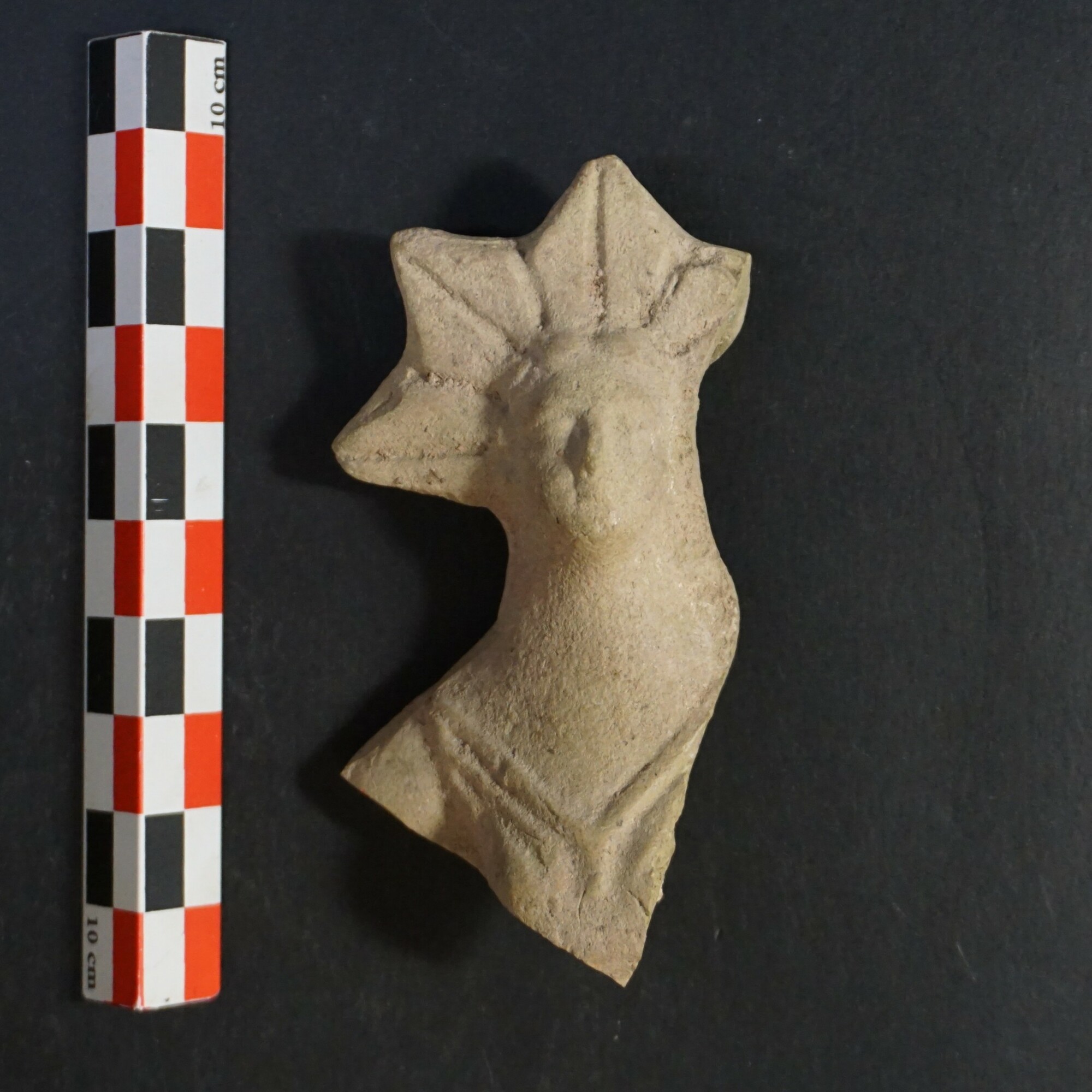
A common expression of reverence to a god or a goddess in the ancient Mediterranean was through the use of statues or idols. In their rituals, the Greeks and Romans treated statues and figures of their gods as vessels for the gods themselves. They treated these statues as they would a god: they would dress, wash, parade, and protect statues of their gods at altars placed in temples and sanctuaries.[1] This artefact is a fragment of a statuette of Helios, the Greek god of the Sun chariot. The characteristic rays coming from the head are a telltale sign that this is the deity being represented.
Helios
Helios occupies an interesting position in the Greek pantheon of gods. As the son of the Titans Hyperion and Theia, he is set apart from the Olympian gods, who are all the descendants of the Titans Kronos and Rhea. Despite this, he is given control over guiding the Sun’s daily course across the sky along with his sister Selene, who guides the course of the moon. The Titan siblings are depicted in the east pediment of the Parthenon piloting their chariots on either side of the pediment’s action, showing the flow of time from one day to the next.[2]
In his earliest depictions on red-figure pottery in the early fifth century BCE, he is shown bearded and in command of a four horse chariot. Over time, he loses his facial hair and is depicted with a more youthful appearance. This change seems to have occurred in the middle fifth century BCE, as the figure of Helios on the Parthenon’s east pediment is clean shaven, a change that is also seen on vases of the time as well as coins minted in the Hellenistic Age.[3]
This aesthetic change marks a shift seen in the fifth and fourth centuries BCE, where the divine association of the Sun and Moon became shared with another pair of godly siblings, Apollo and Artemis.[4]
To our knowledge, Helios was never the subject of any official cults of worship in the Classical period. Unlike popular civic gods like Athena and Apollo, no temples or altars dedicated solely to the worship of Helios have been discovered. This does not necessarily mean Helios received no veneration in the Classical period, as it was common for individuals to worship deities at private altars using statuettes like the one in our collection.[5]
The late Classical and Hellenistic periods saw a renewed reverence for Helios. Alexander the Great was often associated with Helios, and Rhodes became a center for official worship at the end of the fifth century BCE.[6] Famously, Helios was represented on a grand scale via the Colossus of Rhodes, one of the traditional seven wonders of the ancient world. According to Pliny the Elder, it was built between 300 and 280 BCE by the Rhodians by selling and repurposing scrap metal left behind by King Demetrius of the Seleucids after he failed to take the island by force.[7]
Sources
[1] Bremmer, J. 2021. Greek Religion: Second Edition. Cambridge: Cambridge University Press. 31-34, 46.
[2] Hurwit, J. 2017. "Helios Rising: The Sun, the Moon, and the Sea in the Sculptures of the Parthenon." AJA 121: 527-558.
[3] Hoffmann, H. 1963. "Helios." Journal of the American Research Center in Egypt 2: 119-120.
Hurwit 2017: 540
[4] Hurwit 2017, 538.
[5] Hurwit 2017, 539.
[6] Badoud, N. 2024. The Colossus of Rhodes: Archaeology of a Lost Wonder. Oxford: Oxford University Press: 9-12.
[7] As quoted in Badoud 2024, 65.