
Cuneiform tablets
Cuneiform Tablets
Cuneiform script is the earliest known form of writing, invented in Mesopotamia by the Sumerians in the 3500s BCE. Its name comes from the Latin word cuneus meaning "wedge," because the writing system was marked onto fresh clay tablets using a wedge-shaped tool.
Cuneiform script was invented to serve a rather utilitarian purpose. As Sumerian civilization grew more complex, and a multitude of things needed to be accounted for in their storehouses, a need arose for a way to permanently record information in an easy and quick fashion.[1] For this reason, the earliest cuneiform tablets found in the ancient Near East are commercial in nature, serving as a form of ancient spreadsheet.
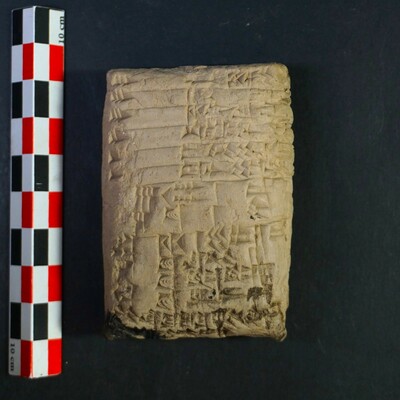
The Akkadian tablet above is notable for its strikingly modern layout. Six rows are clearly defined, with the numbers 30, 30, 30, 20, 10 and 10 marked in Akkadian script (each triangular wedge represents the number ten). To the right of these numbers are more Akkadian signs, which likely describe what is being counted. The Akkadian sign for wood, GISH (or giš), is identifiable in the last row. This sign was used to to signify wood itself or as a determinitive to signal when an object was made of wood.[2]
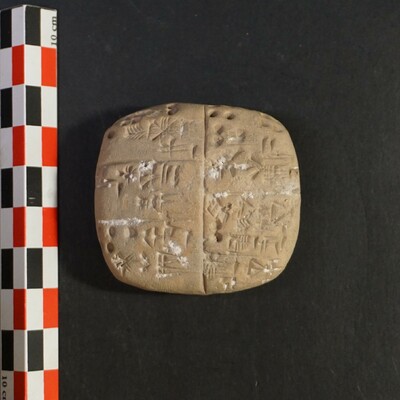
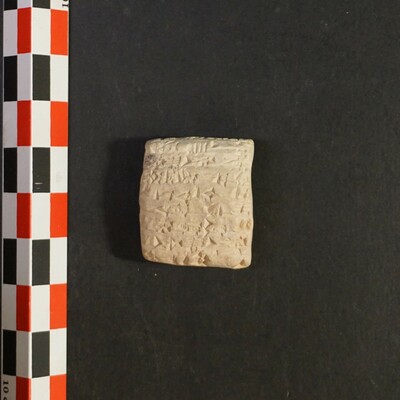
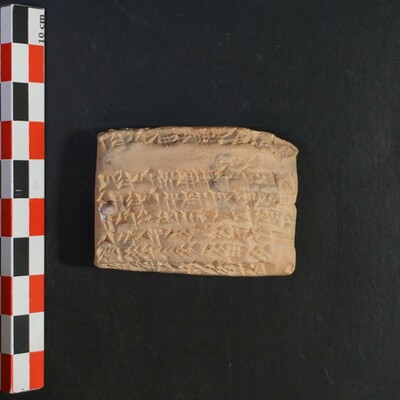
The tablets in our collection are likely all economic tablets. Provided below are translations of two tablets provided by the Yale University Babylonian Collection. From these translations, the purpose of these tablets becomes clear. (Note: sheqels, quarts, and mana are all units of measurement)
Sumerian tablet circa 2650 BCE
"5 quarts of good beer, 3 quarts of bread, 2 sheqel oil, 2 sheqel alkali, 1 fish, 1 bushel
onions (for) Shu-Sin. 6 quarts of beer, 4 quarts of bread, 2 sheqel oil, 2 sheqel alkali, 1
fish, 1 bushel onions for Ilimit. 2 jugs of ordinary beer of 20 quarts, 40 quarts of royal
bread, 1/3 quart of sesame oil, food for the runners. Ilimiti was conveyor. Day 13,
month of the festival of Shulgi. [no year date]"
Neo-Babylonian tablet circa 6th century BCE
"1 mana gold, 2 metal bowls, the votive offering of the king. 14 sheqel and 1/3 golden
goods, the votive offerings of the month of Addaru of the people. Total: 1 mana 54 sheqel gold, ...
1/2 mana 4 sheqel. At the end of the year, the annual import of sheqel to [ ]. 1 mana 19 1/2 sheqel gold..., in gold 2/3 mana 6 sheqel and 1/4 gold.
Total: 2 mana 5 sheqel and 1/3 golden goods for testing. Bel-ibni and Ishtar-shumi-ibni goldsmiths.
In the month of Addaru, the 30th day, the 7th year of Nabonidus, king of Babylon."
Cuneiform writing soon expanded to other purposes. Sumerian writing schools employed a copy-based curriculum to train scribes to write tablets in both Sumerian and Akkadian.[3] These scribes would copy more than just inventory ledgers. As the writing system became increasingly common, its applications extended to modes of self expression like poetry, decrees by kings, laws, land transactions, hymns to the gods, and complaints.[4]
Cuneiform began as a pictographic system, but became more phonographic over time. This means that in its earliest form, a single Sumerian symbol (or pictograph) represented a word or concept, such as a drawing of a bowl representing food, or a drawing of a head of barley representing barley. After thousands of years, these pictographs became more and more abstracted, eventually giving rise to a phonographic system of writing, where syllables come together to form words representing objects, people, and ideas.[5]
Cuneiform writing was also adapted to communicate multiple different languages, such as Akkadian, Sumerian, Babylonian, Elamite, Assyrian, Old Persian, and Urartian. Sumerian was the ancestor of most of these languages, but once it fell out of use at the end of the third millenium BCE it remained as a lingua sacra, which is similar to the role ancient Latin plays in our world today. At the beginning of the second millenium BCE, Akkadian became Mesopotamia's lingua franca, connecting the many disparate city states with their own languages under a common tongue. In this time period it was common to see decrees to the public written bilingually.[6]
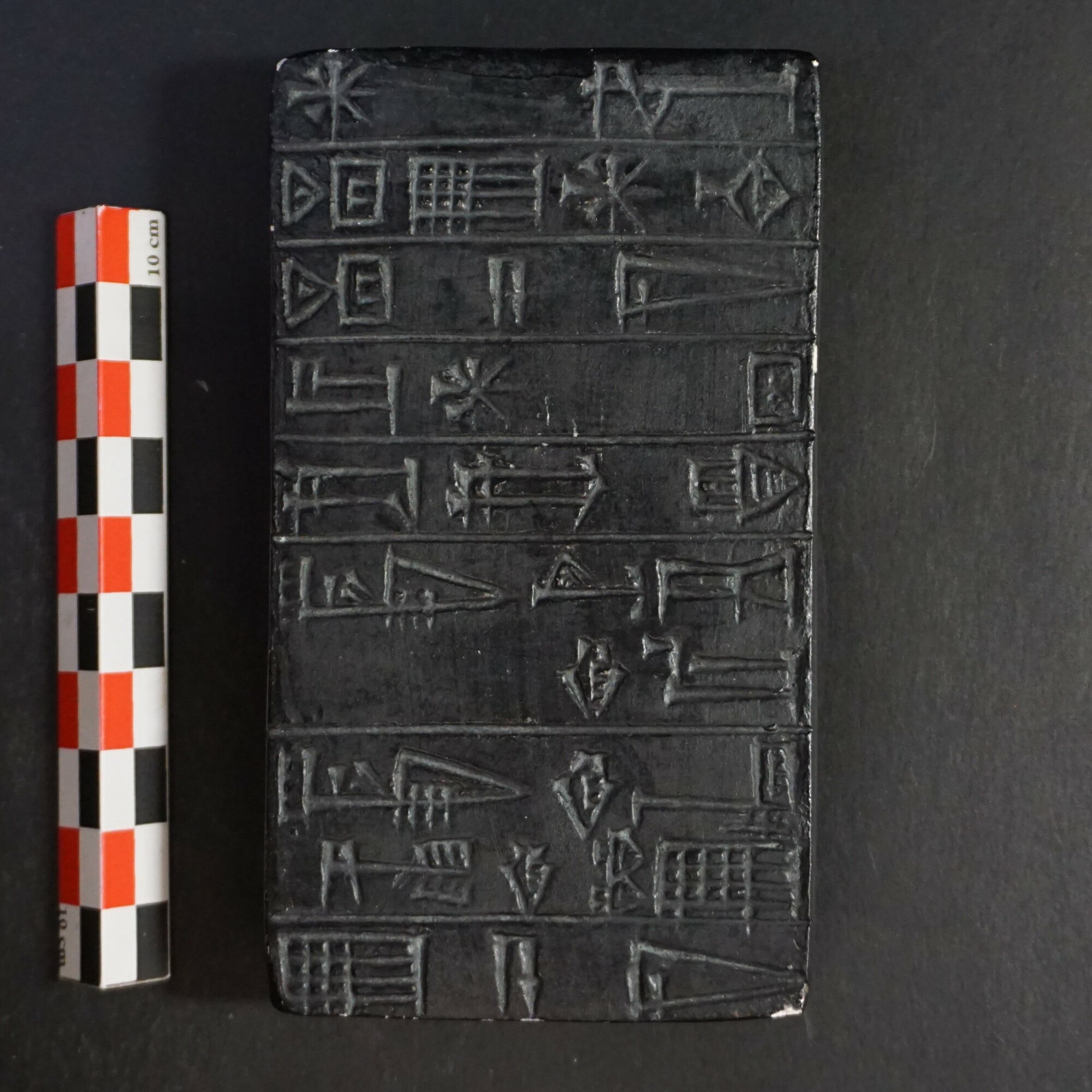
Building Certificate in Cuneiform Script (reproduction)
Original: Near-Eastern Museum, Berlin, Germany (VA-10945)
This is a plaster reproduction of a Sumerian tablet housed at the Near-Eastern Museum in Berlin. The text commemorates the restoration of a temple to the goddess Inanna (Babylonian Ishtar) in Uruk by the first king of the third dynasty of Ur. It reads:
"To the goddess Inanna, the mistress of Eanna, his mistress, Ur-Nammu,
the mighty man, the king of Ur, king of Sumer and Akkad,
has built her temple (and) restored it in its place." [7]
The tablet begins with an invocation of the goddess Inanna, and thus begins with the sumerogram for the determinative for divinity, DINGIL, which specifies that the next sumerogram INANNA is referring to the goddess. The sixth and seventh lines start with the sumerogram LUGAL meaning "king" in reference to Ur-Nammu's titles as king of Ur, Sumer and Akkad.
A lot of interesting information can be taken from this translation. The inscription refers to a building project of the Sumerian king Ur-Nammu in the city of Uruk, which at the time was under the control of the city of Ur. The tablet is attributed to King Ur-Nammu, whose exact years of rule are unclear; possibly 2047-2030 BCE by the short chronology or 2112-2094 BCE by the middle chronology. Ur-Nammu was the first king of the third dynasty of Ur in ancient Sumer. He is best known for founding a powerful dynasty in Ur along with his brother, the king of Uruk. He is also known for his extensive and lavish building projects, including temples to deities.[8]
This inscription mentions the Sumerian goddess Inanna, the goddess of sexuality, love, and war, who is identified as Ishtar by the later Babylonians and Assyrians. In the time of Ur-Nammu, Uruk was thought to be the epicentre of Inanna worship, in Eanna - the main temple complex of Inanna.[9] The worship of Inanna in Uruk features prominently in stories like the Epic of Gilgamesh, a famous and hugely influential tale recounted in Mesopotamia about the adventures of the pseudo-mythological king of Uruk.
Sources
[1] Fagan, B. 1986. People of the Earth: An Introduction to World Prehistory: Fifth Edition. Boston: Little, Brown and Company. 337-338.
[2] Huehnergard, J. 2011. "A Grammar of Akkadian, third edition." Brill. 138.
Labat, R., and Malbrat-Labat, F. 1976. Manuel d'Épigraphie Akkadienne, 6e édition. Paris: Société Nouvelle Librairie Orientaliste Paul Geuthner. 21, 137.
[3] Garrison, M. 2012. "Antiquarianism, Copying, Collecting." In A Companion to the Archaeology of the Ancient Near East, edited by D. T. Potts. Oxford: Wiley Blackwell. 28.
[4] Fagan 1986: 337.
[5] Garrison 2012: 97-98
Fagan 1986: 338.
[6] Garrison 2012: 100.
[7] The original artefact in the Near-Eastern Museum, Berlin: https://id.smb.museum/object/1744352/bauurkunde
[8] Heinz, M. 2012. "The Ur III, Old Babylonian, and Kassite Empires." In A Companion to the Archaeology of the Ancient Near East, edited by D. T. Potts. Oxford: Wiley Blackwell. 709-710.
Middleton, J. 2005. "Ur-Nammu." World Monarchies and Dynasties, first edition. New York: Routledge. 979
[9] Darvill, T. 2021. "Uruk (Warka), Iraq." The Concise Oxford Dictionary of Archaeology. Oxford: Oxford University Press
Heinz, M. 2013. "Public Buildings, Palaces and Temples." In The Sumerian World, edited by H. Crawford. London: Routledge. 182-194.