
Stylus and Diptych
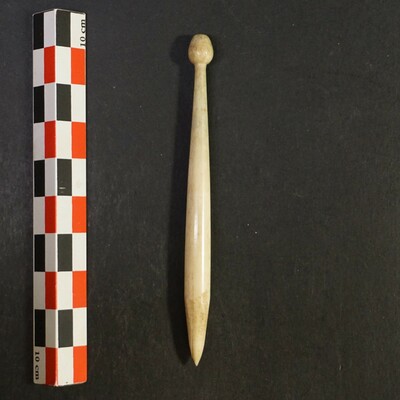
Stylus
The stylus has long been an essential writing tool. Styluses could be made from various materials such as bronze, bones, or reeds, all shaped into a point. This allowed for the writer to etch their message on a workable material such as clay or wax.
Styluses could also be multifunctional. For example, this white stylus has a rounded side which could have been used to press and smooth a surface after writing, much like a modern eraser.
After the collapse of the Western Roman Empire and the beginning of the Middle Ages, the ability to read and write became less common. The practice was kept alive by scribes in churches and monasteries in Europe, who were interested in copying scripture for the purposes of spreading Christianity.
In this period, the dominant material used as styluses were primary bird feathers, usually from a goose or a swan. The quill pen’s replacement of reed or bone as the preferred material was likely due to its relative abundance in northwestern Europe, as well as its flexibility and ability to be carved to a point.[1]
The advent of the printing press in the 15th century and the cheapening of paper production greatly reduced the importance of styluses and the wax tablets used by the Romans, making them relics of a bygone era.
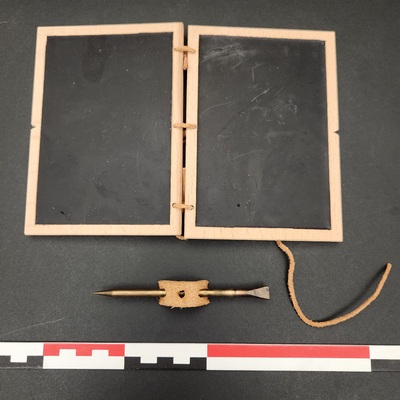
Diptych
In the context of writing and languages, a diptych refers to a pair of tablets hinged with string with a waxed surface on each inner side.
A stylus would be used to etch the text into the wax, which could then be smoothened for reuse. As such, diptychs weren’t meant for permanent content, but rather for disposable writings. Their use spanned different cultures throughout Europe, Africa and Asia, and periods from the 14th century BCE up to the 19th century CE. Many representations of diptychs appear in frescos in Pompeii and Herculaneum. Most of the figures holding dyptichs are female, perhaps to invoke the likeness of the Muses.[2]
Sources
[1] Whalley, J. 1975. Writing implements and accessories: from the Roman stylus to the typewriter. Detroit: Gale Research Co. 16.
[2] Meyer, E. 2009. "Writing Paraphernalia, Tablets, and Muses in Campanian Wall Painting." Archaeological Journal of America 113: 569-583.