
Phaistos disk (reproduction)
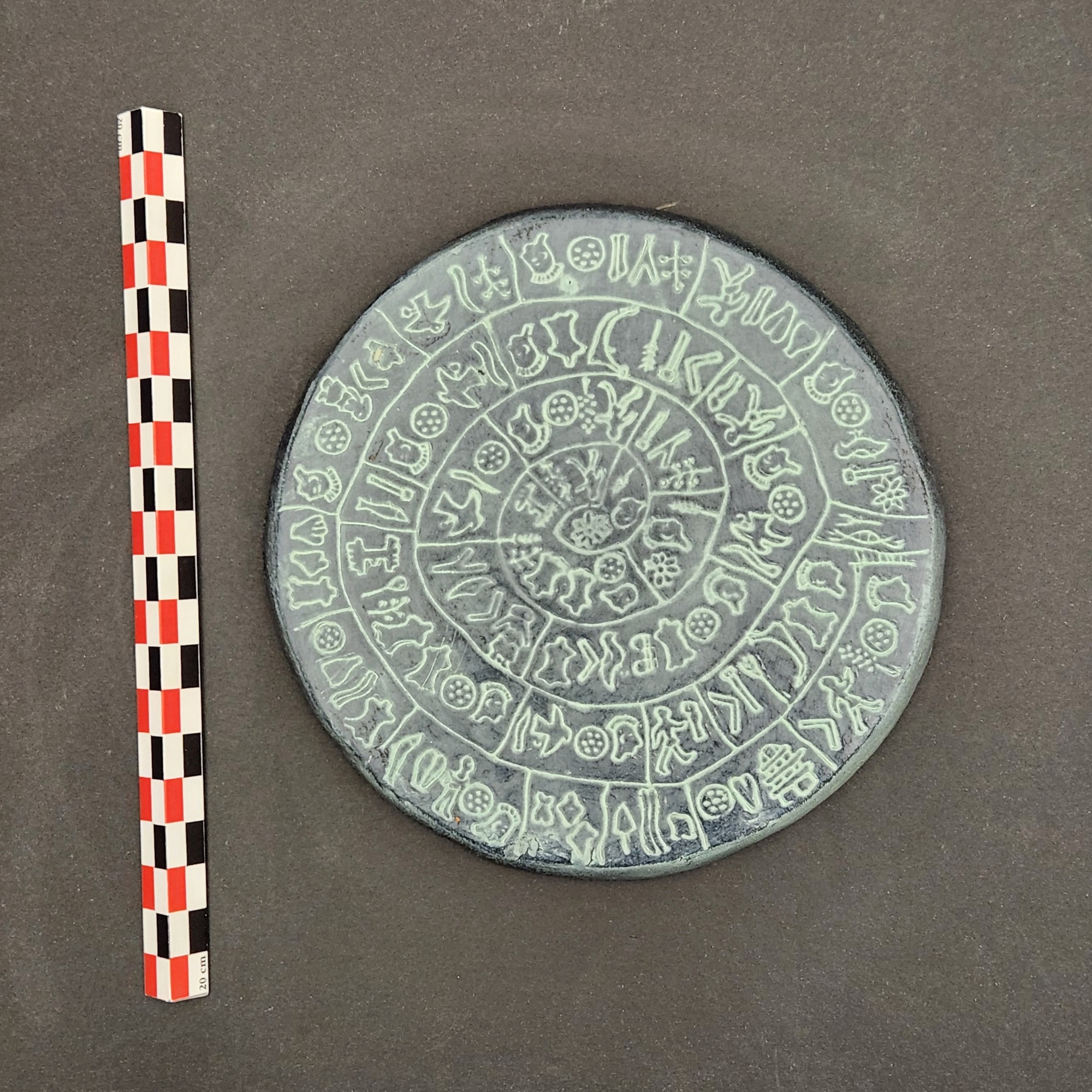
Phaistos Disk (reproduction)
Original: Heraklion Museum, Heraklion, Greece (Π-Ν1358)
The Phaistos Disk is one of the most fascinating objects from the Minoan civilization. Experts are still unsure about its relation to Linear A and Linear B since it remains undeciphered, but linguistic analysis suggests a connection to Linear A.[1] This fired clay disc is impressed on both sides with a total of 241 symbols made up of 45 unique characters and is set in a spiral arrangement of 61 total boxes. The reproduction housed at our museum only shows side A, which contains 31 boxes and is marked by the floral pattern at the center of the spiral.
The original disk was discovered by Luigi Pernier in 1908 in the basement of the Phaistos Palace in southern Crete.[2] It remains so mysterious because of the uniqueness of its script. Even after 100 years, no other examples have been found. However, many attempts have been made to decipher the script and interpret its purpose.
In 2009, Wolfgang Reczko suggested that the Phaistos disk is an ancient solar eclipse calendar. According to their analysis of the disk’s layout, there are 18 boxes containing symbols in the inner spiral, which they theorise to be a representation of the 18 year repetition of the Saros cycle of solar eclipses. The order that duplicate symbols appear in these boxes around the spiral seem to correspond to NASA’s predicted solar eclipses in the Phaistos Palace area – where the disk was found – starting in the year 1377 BCE. This is an interesting discovery, since it challenges the generally accepted date placement. Additionally, the 12 boxes around the rim of the spiral may correspond to the 12 months of the year used in many cultures of the age.[3]
Linear A and Linear B
Linear A and Linear B are writing systems that were used in the early Greek world in the 2nd millennium BCE. While Linear B was deciphered in 1952, Linear A remains a mystery.
Linear B is the oldest form of the Greek language discovered so far. Like ancient cuneiform, it was used by the Mycenaeans to compile lists and inventories of palaces and temples.[4]
Sources
[1] Davis, B. 2018. "The Phaistos Disk: A New Way of Viewing the Language Behind the Script." Oxford Journal of Archaeology 37: 373-410.
[2] Robinson, A. 2008. "A century of puzzling believed to be the world's first printed document, the Phaistos Disc was unearthed 100 years ago. Andrew Robinson explains why this remarkable object remains undeciphered." Nature 453.7198: 990.
[3] Reczko, W. 2009. "Analyzing and dating the structure of the Phaistos Disk." Archaeological and Anthropological Sciences 1: 241–245.
[4] Shapland, A. 2025. The Emergence of Aegean Prehistory. Cambridge: Cambridge University Press. 16.