
Stele of the goddess Tanit
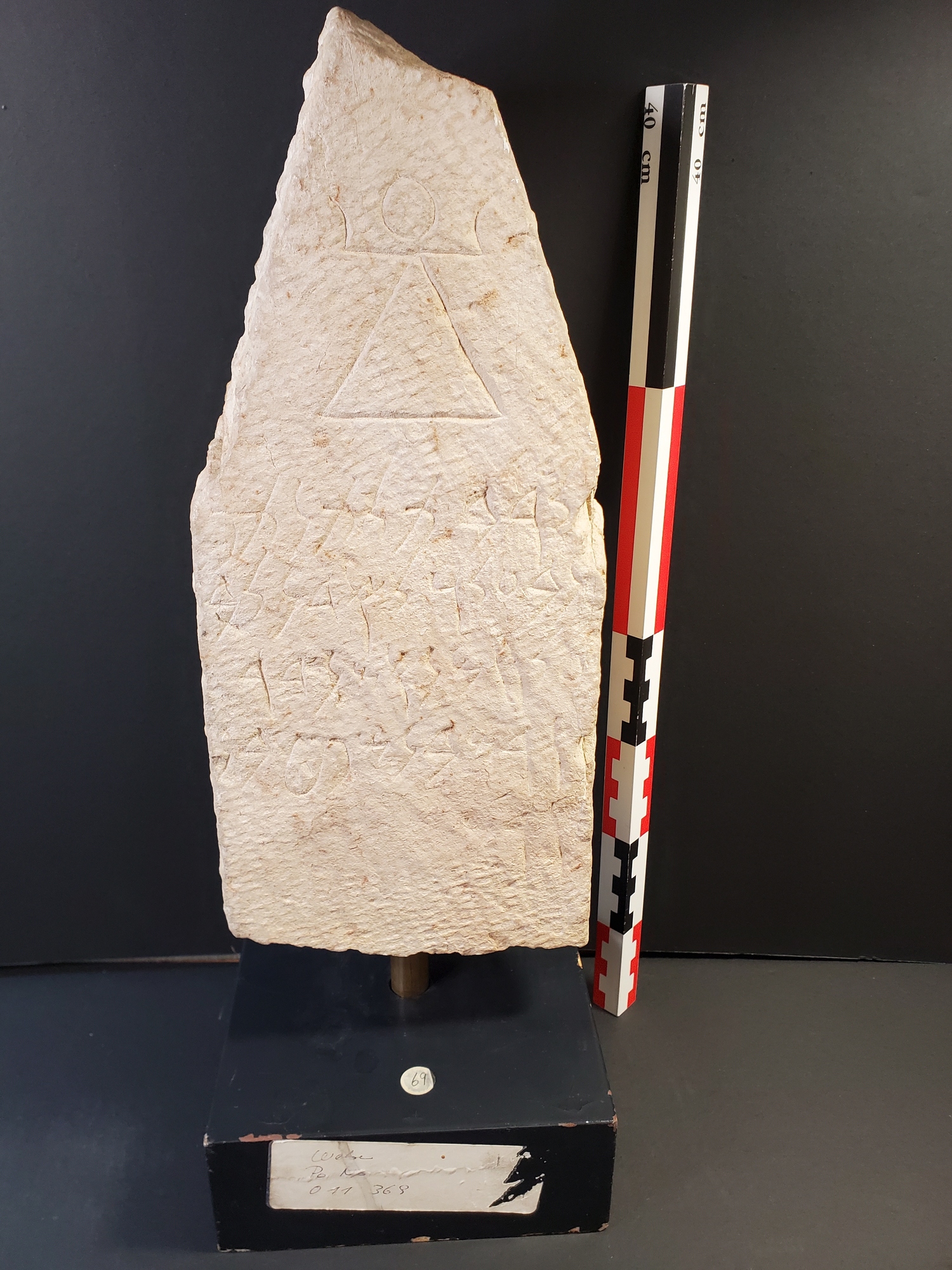
This piece of limestone is what is referred to as a stele, an upright monolith that contains an inscription written for display to the public. A stele’s inscription can serve commemorative, funerary, or religious purposes.[1]
In this case, the inscription conveys notable reverence to Tanit, a Carthaginian goddess. The top of the stele contains a common symbol of the goddess, and the inscription in the Phoenician language reads:
"To the Lady Tanit,
Face of Ba’al, and
to the Lord Ba’al-
Hammon, which Arish,
son of Shaphat, son
of Arish, vowed."[2]
There is much to unpack in this short inscription, and it represents thousands of years of religious tradition and relates to deep-rooted historical bias. But first, who are the Carthaginians, and who are the Phoenicians?
The Phoenicians were a well-travelled and highly influential Semitic culture originating on the eastern coast of the Mediterranean. From the late second millennium BCE onward, they sailed the Mediterranean end-to-end and established over a dozen successful trading colonies, most notably the city of Carthage in modern day Tunisia.[3] They were the first to develop and use a phonographic writing system that would later be adapted by early Greeks and Italians starting in the 8th century BCE to form what we recognize today as the alphabet.
Like the Greeks and the Egyptians nearby, the Phoenicians had their own pantheon of gods. These deities were influenced by earlier Sumerian and Babylonian mythology, and went on to inspire and influence later Greek, Roman, and Abrahamic religious beliefs and practices. A strong example of this interconnection is the Phoenician goddess Astarte and her connection to the Babylonian goddess Ishtar, the Greek goddess Aphrodite, and the Carthaginian goddess Tanit.
In the Phoenician belief system, Astarte held the prestigious epithet “Queen of Heaven”, and was associated with the sea and the morning and evening stars.[4] She was also associated with love, fertility, and war. These descriptions may sound familiar to a fan of Greek and Roman mythology, because many of these also describe Aphrodite and Venus. This is no coincidence. Since the Phoenicians were such prolific mariners, it is likely that the Greeks inherited the idea of a feminine goddess of fertility and love that was also associated with the morning and evening stars.[5] Since Carthage was a colony of the Phoenicians, they also developed their own form of Astarte, known as Tanit, whose triangle symbol can be seen on the artefact.
Astarte was not an invention of the Phoencians wholesale. Dating back further, in the fourth millennium BCE in Mesopotamia, there is the Sumerian Inanna (and later Assyrian and Babylonian Ishtar), who was a revered and feared mother goddess. She is the origin of the epithet “Queen of Heaven”, since it was believed that Ishtar was the divine wife of the Assyrian king.[6] The worship of Ishtar spread to the land of the Caananites and later the Phoenicians through cultural exchange as well as conquest, and from the Phoenicians to their colonies.
If the translation of the inscription is analysed, more about Carthaginian religion may be learned. In the second line of the inscription, Tanit is referred to as the “Face of Ba’al”, which was a common epithet given to the goddess.[7] The stele is also addressed to Ba’al-Hammon, the father of Tanit and the creator of the universe in Phoenician religion.[8] The last three lines refer to a person named Arish, his father Shaphat, and his grandfather Arish. This is likely the name of the person who erected the stele, and he wished to take credit for something in the eyes of their gods. What exactly the stele and its inscription is commemorating depends on what you choose to believe.
As mentioned, Tanit originated as Astarte, a Semitic goddess of fertility and love worshipped in the Levant by the Phoenicians in the late Bronze and early Iron Age. The Phoenicians are believed to be descendants of the Caananites, who were the inhabitants of what is now the land of Palestine before the arrival of the ancient Israelites. Canaan played a major role in early Jewish history and the writings of the Old Testament.
An attentive reader of scripture might have recognized the word Ba’al. It is a Semitic word meaning “lord” and was often used to describe a powerful deity and was applied to many Canaanite gods. On the stele it is used in the name Ba’al-Hammon to refer to the Carthaginian creator deity, equated with the greek Kronos and the Roman Saturn.[9] Due to the conflicts between the early Hebrews and the Canaanites in Palestine, the Canaanite gods received a poor reputation in the eyes of the authors of what would become the Hebrew Bible. The non-Israelite religions were viewed as false and evil gods, so negative traits were erroneously assigned to their worshippers.
An example of this is Moloch or Melek, which is referred to in Leviticus 18:21, 2 Kings 23:10 and Deuteronomy 18:10 (additionally, it is equated to Ba’al in Jeremiah 19:5) as a Canaanite deity that demands the sacrifice of firstborn children at a tophet. The historicity of this figure and this ritual are dubious and hotly debated by experts. Evidence of cremated bones of infants have been found in Carthage with inscriptions to Tanit and Ba’al-Hammon, but it is possible that these are burials of stillborn children offered to the gods in return for their blessing on future childbearing, but has been misinterpreted by the ancient Israelite writers and modern Christian archaeologists.[10]
This religious baggage carries weight in the modern day. Due to Carthage’s deep connection to the Phoenicians, this thinking has been applied to their pantheon, including Tanit. When studying artefacts, it is important to view them from an impartial perspective, in order to not revive old grudges that might distort our view of an artefact’s significance. This stele may be commemorating a child sacrifice, but the evidence for this is almost non-existent except for classical sources like Diodorus Siculus (Library of History 20.14) or biblical sources. There is no written work from Carthage itself, and there is no consensus on the present archaeological evidence.
In conclusion, the invocation of the Carthaginian goddess Tanit on the stele brings to mind millennia of cultural exchange in the Mediterranean, with the idea of a goddess of fertility and warfare originating from the distant land of ancient Sumer and spreading to the coasts of Greece, Italy, and North Africa under new names. It proves that no culture exists in a vacuum, and is constantly influencing and being influenced by the cultures that surround it. It is also symbolic of the importance of not allowing historical bias to colour out views of ancient cultures.
Sources
[1] Darvill, T. 2021. "Stela." In The Concise Oxford Dictionary of Archaeology. Oxford: Oxford University Press.
[2] Translated and verified by University of Toronto Professor J. Brian Peckham in 1988.
[3] Darvill, T. 2021. "Phoenicians." In The Concise Oxford Dictionary of Archaeology. Oxford: Oxford University Press.
[4] Leeming, D. 2005. "Astarte." In The Oxford Companion to World Mythology. Oxford: Oxford University Press.
[5] Budin, S. 2014. "Before Kypris was Aphrodite." in Transformation of a Goddess: Ishtar – Astarte – Aphrodite, edited by D. T. Sugimoto. Fribourg: Academic Press Fribourg. 195-215.
[6] Marcovich, M. 1996. "From Ishtar to Aphrodite." Journal of Aesthetic Education 30: 46.
[7] Darvill, T. 2021. "Tanit." In The Concise Oxford Dictionary of Archaeology. Oxford: Oxford University Press.
[8] Scheub, H. "Baal Hammon Struggles with the God of Death." In A Dictionary of African Mythology. Oxford: Oxford University Press.
[8] Burke, D. 1993. "Baal." In The Oxford Companion to the Bible. Oxford: Oxford University Press.
[9] Cooper, A. 2005. "Phoenician Religion." In Encyclopedia of Religion, edited by L. Jones. 7128-7133. Detroit: Macmillan.
[10] Holm, T. 2005. "Phoenician Religion [Further Considerations]." In Encyclopedia of Religion, edited by L. Jones. Detroit: Macmillan. 7134-7135.